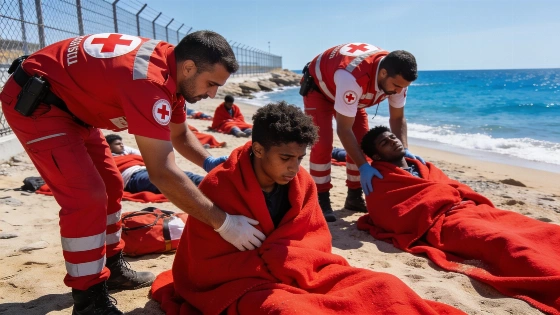
Ceuta has declared an emergency after over 1,000 migrants arrived in a week. Red Cross teams provide urgent aid to exhausted young people, mostly Moroccans, reaching the Spanish coast by swimming.
Ceuta is once again at the center of Spain’s migration debate after more than 1,000 people, mainly young Moroccans, reached its shores by swimming in just one week. The city’s authorities have declared an emergency, highlighting the pressure on local services and the Red Cross, which is the first to assist those arriving in often critical condition. Many of these young migrants are seen wrapped in the organization’s distinctive red blankets, recovering from hours in the water and requiring immediate medical attention.
According to José Javier Sánchez Espinosa, head of Migration at Cruz Roja Española, the situation in Ceuta is not new. He notes that arrivals have been steady for over a year, with numbers fluctuating but rarely dropping to zero. The recent spike is attributed by some to a Supreme Court ruling from July 8, which restricts the immediate return of migrants who reach Spanish territory by their own means, provided they have not breached border barriers. However, Sánchez Espinosa points out that the causes are complex and often linked to individual motivations and seasonal factors, such as favorable weather conditions.
Red Cross teams in Ceuta are tasked with triaging new arrivals, assessing their health, and providing basic care—ranging from treating minor wounds and abrasions to offering warm drinks and dry clothing. The organization does not handle the longer-term accommodation or transfers to the mainland; these responsibilities fall to administrative authorities. While most arrivals are young Moroccans, there are also smaller groups from sub-Saharan Africa, whose journeys are typically longer and more perilous, making their cases particularly sensitive.
Despite the recurring nature of these emergencies, the Red Cross has reinforced its coastal teams since 2024, aiming to better manage the unpredictable flow of people. Sánchez Espinosa describes the current situation as a challenge, but not unprecedented. He emphasizes that the organization’s approach is to focus on immediate humanitarian needs rather than political analysis or speculation about the so-called “pull effect” of legal changes.
Family members of missing migrants often contact the Red Cross in search of information, especially when there are reports of deaths or disappearances at sea. The organization maintains a project to cross-reference data from authorities with inquiries from relatives, always respecting privacy and data protection. However, requests for information about missing persons typically come with a delay, as families may not realize immediately that someone is unaccounted for.
Ceuta’s recurring emergencies reflect broader migration trends affecting Spain’s southern borders. Similar patterns are observed in the Canary Islands and, increasingly, in the Balearic Islands, where favorable weather also encourages risky crossings. The Red Cross’s experience in these regions has led to the development of specialized response teams, but the scale and unpredictability of arrivals continue to test their capacity.
In the context of Spain’s ongoing migration challenges, the situation in Ceuta underscores the need for coordinated action between humanitarian organizations and government agencies. The city’s proximity to Morocco and its unique legal status make it a focal point for both migration flows and policy debates. For those interested in how Spanish society and culture intersect with international attention, recent events such as the high-profile celebration of Spanish fashion in Paris, as seen in Nieves Álvarez’s appearance in a Redondo Brand dress, offer a contrasting perspective on Spain’s global image.
Spain’s border regions have long been entry points for migrants seeking safety and opportunity in Europe. Ceuta, as one of two Spanish enclaves in North Africa, faces unique pressures due to its geography and legal framework. The Supreme Court’s recent decision may influence future migration patterns, but the underlying drivers—economic hardship, instability, and the search for a better life—remain unchanged. The Red Cross’s ongoing presence on the ground is a reminder of the human dimension behind the headlines, as well as the operational demands placed on emergency services in Spain’s border territories.