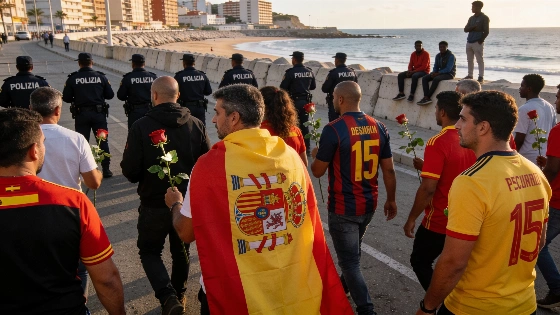
Ceuta saw new protests as residents demanded the removal of migrants. The demonstration followed recent unrest and arson at a beach camp. Authorities increased police presence to prevent further violence.
Ceuta experienced another day of unrest as local residents gathered to demand the expulsion of migrants who entered the city in late July. The demonstration, which drew hundreds by the evening, unfolded just one day after violent incidents at El Trampolín beach, where a makeshift migrant camp was set on fire and attempts were made to block humanitarian aid. Despite the tense atmosphere, Friday’s protest remained largely peaceful, with only minor disturbances reported.
Protesters assembled in front of the Delegación del Gobierno, carrying carnations and chanting “Ceuta unida jamás será vencida.” Spanish and Ceuta flags were visible throughout the crowd, which included families, children, and supporters from other regions such as Valencia and Granada. The group marched through the city for nearly three hours, their numbers swelling as they advanced, and repeatedly called for the removal of migrants with slogans like “invasores, expulsión.”
Police maintained a strong presence, with more than fifteen officers from the Unidades de Intervención Policial (UIP) leading the march and additional agents stationed along the route. By the time the protest reached a supermarket on Avenida de España, police sources estimated the crowd at around 500 participants. Demonstrators paused to show support for military personnel guarding the area, shouting “no estáis solos,” before resuming their calls for expulsion.
Nearby, groups of migrants watched from a breakwater close to the beach where the previous night’s fire had occurred. Police blocked access to the area to prevent further confrontations and to ensure that aid distribution by Cruz Roja could continue without interference. Some residents voiced frustration, insisting that only umbrellas had been burned, not entire camps, but acknowledged the ongoing anger in the community.
The central government and local authorities, including Juan Jesús Vivas’s team, appealed for calm and social peace following Thursday’s violence. The Minister of Inclusion, Social Security and Migration, Elma Saiz, urged that Cruz Roja volunteers be allowed to work safely. Human rights organizations, including Amnistía Internacional, expressed deep concern over the escalation of street tension and the threats faced by aid workers. Amnistía called for guarantees that humanitarian staff could operate without fear or obstruction.
Since the start of August, the government and Cruz Roja Española have distributed emergency aid to migrants, beginning with 2,500 daily kits at El Trampolín and expanding as needs grew. By August 27, authorities reported the delivery of 93,650 food kits, 1,396 feminine hygiene kits, and 2,150 male hygiene kits. The scale of the operation reflects the ongoing challenge of managing the influx of thousands of people who crossed from Morocco nearly a month ago.
Ceuta’s situation highlights the broader pressures facing Spain’s border regions, where migration flows can quickly lead to social tension and political debate. The government’s response has included both humanitarian support and increased security measures. This approach mirrors other recent policy shifts, such as the push for stricter drink-driving limits to improve public safety, as seen in the recent debate over alcohol limits for drivers. The events in Ceuta underscore the delicate balance between maintaining order, upholding humanitarian principles, and addressing the concerns of local communities.
Ceuta, a Spanish enclave on the North African coast, has long been a focal point for migration from Morocco and beyond. The city’s unique position makes it both a gateway and a flashpoint, with local authorities often caught between national policy and immediate realities on the ground. The recent protests and the government’s ongoing aid efforts illustrate the complexity of managing migration in a context of heightened public scrutiny and persistent social tension.