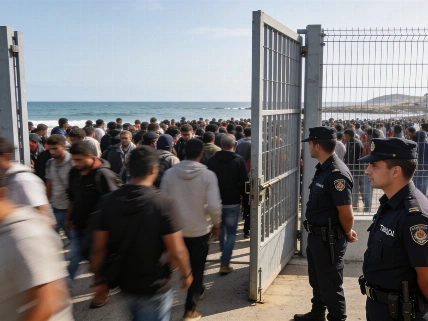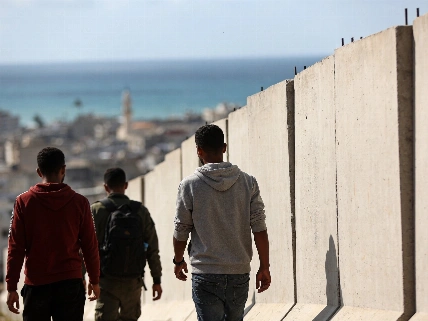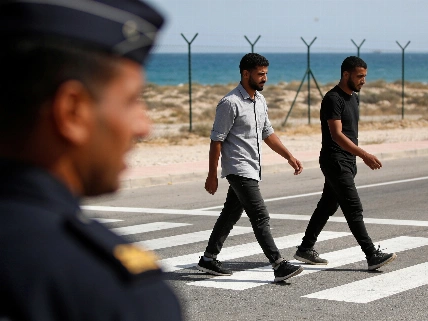
More than 350 Spanish officers moved about 500 people from migrant settlements in Ceuta on Sunday, including around 200 minors. Several dozen ran for nearby hills as the operation began.
At about 7 a.m. on Sunday, 18 October, more than 350 Spanish National Police officers moved into informal settlements across Ceuta. Several dozen people ran into the hills near Tarajal after spotting the operation. About 500 people were moved, including around 200 minors.
The operation covered Tarajal and Poblado de Regulares, along with Los Rosales and the lower part of the Príncipe Alfonso neighbourhood. Most officers came from the UIP riot-control unit or the UPR prevention and response unit.
About 400 people had been living in the Tarajal camp, with another 90 in Poblado de Regulares. Police took those they removed to the Centro de Atención Temporal de Extranjeros del Tarajal, or CATE, for identification and registration. They were then due to move to accommodation provided by Spain’s Ministry of Inclusion, Social Security and Migration. Loma Colmenar was one planned destination; some people could also opt to return voluntarily to Morocco.
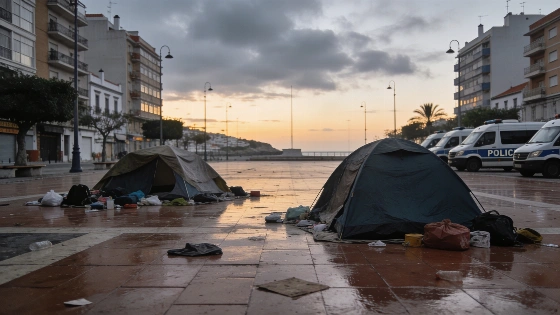
The operation also covered former industrial premises in Tarajal and a site beside the CETI where the Hípica camp stood. After the residents were moved, work began to dismantle the tents and makeshift shelters. Crews then cleared the sites.
David de la Encina, the Spanish government’s representative in Ceuta, praised the police operation. He said searches for migrants staying in neighbourhoods would continue over the coming days. Further locations were under scrutiny because many people were known to be staying there.
Sunday’s clearance was part of a wider campaign against informal settlements that grew after the mass arrivals from Morocco on 30 and 31 July. On 18 September, earlier operations moved around 1,700 people from Benítez and Trampolín beaches to two prepared sites in the port. Temporary structures at Trampolín were dismantled on 4 and 5 October, when about 2,000 people were moved. A later operation at Fábrica del Guano brought about 600 people to the CATE. After previous sites were cleared, some residents moved to other parts of the city.
Authorities do not know how many migrants remain in Ceuta. They include people from the Maghreb and sub-Saharan Africa who arrived in the surge of more than 80,000 people crossing from Morocco on 30 and 31 July. Most returned soon afterwards. Some of those who stayed remained on the streets or at beaches. Others were in industrial areas. The influx caused a serious socioeconomic crisis in the city and public discontent with the government.