Spain’s Interior Ministry has raised the security level at Ceuta’s port after plans for a migrant camp moved forward without the required safety assessment. The government has not released the risk report, despite repeated requests from local authorities.
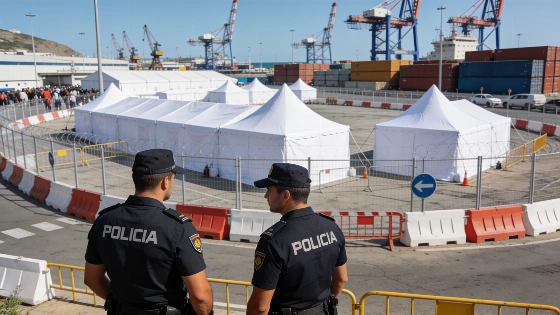
Plans to set up a migrant camp for about a thousand people on Ceuta’s port grounds have led to a direct security escalation. The Interior Ministry has raised the port’s maritime protection to Level 2, citing increased risks to critical infrastructure after the Transport Ministry took control of two port plots for the project. This decision comes as the government continues to withhold a key risk assessment, despite repeated written requests from the Ceuta Port Authority. According to official statements reported by Spanish media, the heightened alert is tied to concerns about the camp’s proximity to sensitive fuel and energy facilities within the port.
The dispute began when Transport Minister Óscar Puente signed a resolution on September 5, authorizing the use of 16,000 square meters of port land for the camp. This overruled the Ceuta Port Authority’s board, which had rejected the plan by 11 votes to 4, citing security concerns. The resolution referenced an internal report from Puertos del Estado, which reportedly justified the project on public interest grounds, while also acknowledging increased risks to port operations and infrastructure. Spain’s main police union, the Sindicato Unificado de Policía (SUP), has called for the project to be stopped immediately, arguing that the site’s location next to critical infrastructure poses evacuation, fire, and overall port safety risks, as reported by El Confidencial and other outlets.
On September 15, Spain's National Court temporarily suspended the Ceuta port migrant camp project, pending review of a police union lawsuit over safety concerns.
For eleven days, the Ceuta Port Authority has been unable to obtain the risk report. Four separate requests—two to Puertos del Estado and two to the Ministry of Transport’s State Secretariat—have gone unanswered. The missing document is central, as it is cited as the basis for the government’s authorization, and without it, local officials say they cannot assess or implement the required safety measures. According to Caliber.az and other sources, the port administration has repeatedly stated that without access to the risk assessment, it cannot properly evaluate or enforce security protocols for such a sensitive installation.
On September 9, the Interior Ministry’s State Secretariat for Security intervened, officially raising the port’s maritime protection status. The order, signed by Aina Calvo Sastre, warns that the temporary occupation of port land for a large-scale humanitarian facility "substantially alters the ordinary conditions of operation and protection" and increases risks related to access control, separation of restricted and operational areas, and the safeguarding of critical infrastructure. The directive echoes technical objections previously raised by the Ceuta Port Authority in three separate reports opposing the camp. As reported by Moncloa.com, the Level 2 alert requires stricter access controls, clear separation between humanitarian and operational zones, and reinforced port security measures.
The port has been instructed to physically separate the humanitarian area from operational and embarkation zones with controlled fencing and to reinforce all maritime protection measures. However, Ceuta’s port officials responded on September 14 that they lack technical details about the planned installation, making it impossible to comply with the new security requirements. They have since requested further information from the government, Puertos del Estado, and the Ministry of Transport regarding the Level 2 alert. Only Gustavo Santana, president of Puertos del Estado, has replied, clarifying that the heightened security applies to the entire port, not just the camp area, and must be enforced immediately.
Port Authority president Juan Manuel Doncel has warned that if the migrant camp remains on port grounds until 2027, the resulting operational and commercial losses could reach up to 600 million euros.
Despite these concerns, the government has not provided the risk report referenced by Óscar Puente. The camp’s construction is nearly finished, but the lack of transparency has led to legal action. On September 15, the National Court suspended the project after the Sindicato Unificado de Policía (SUP) argued that authorities had failed to verify the camp’s compatibility with port operations, safety, civil protection, and emergency protocols. The SUP had previously requested this information from all relevant agencies on September 13, but received no response. According to Reuters, the situation remains tense, with more than 800 migrants recently transferred to a new reception center in Ceuta, and over 10,000 migrants reportedly still present in the city after a recent surge.
This episode reflects a pattern of government intervention in strategic enclaves, similar to the recent push for permanent EU status for Ceuta and Melilla. The Ceuta port dispute highlights the tension between national priorities and local operational realities, especially when critical infrastructure and security are involved. The government’s refusal to release the risk assessment has undermined local authority and raised questions about transparency and the balance of power in Spain’s management of migration and border security. Until the documentation is disclosed and safety protocols are clarified, the project remains suspended, with operational uncertainty overshadowing any humanitarian aims.