More than 1,000 minors remain on Ceuta's streets after the summer arrivals. Police and welfare services send them between offices and full shelters, while a political dispute holds up transfers to mainland accommodation.
More than 1,000 minors are still sleeping rough in Ceuta because there is nowhere to place them. They move between police headquarters and children's centres that can only tell them there is no room. Their daily route has become a closed loop. Identification and protection depend on accommodation that does not exist.
Groups of boys as young as 14 go to the Jefatura Superior de la Policía but are turned away before registration. Staff say the children cannot be identified until a facility is ready to receive them. At centres such as Piniers, the answer is the opposite. Without police identification, there is no admission.
The first 10 individual procedures for minors from the July crossing were reportedly opened on 14 September 2026, almost two months after the mass arrival.
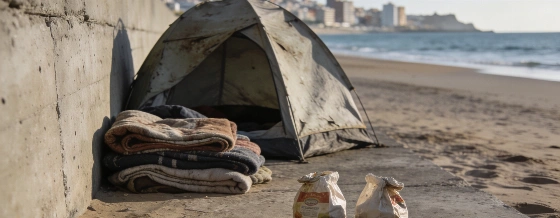
The result is a bureaucratic loop with a physical cost. Some minors sleep on beaches or in makeshift settlements around Sidi Embarek and El Príncipe. Residents in poorer neighbourhoods have taken in others. Fifty days after the mass crossing, most of those still on the streets are boys aged between 14 and 17.
The numbers show why individual cases keep getting lost in the emergency. Ceuta already had around 700 unaccompanied minors in its protection system before July. About 1,300 more crossed between 30 and 31 July. Since then, 2,200 minors have been registered. The city has 22 reception resources, while the central government says only 29 ordinary places are available.
Youness, 16, is among those left outside. He stopped making the trip between the police and the centres. Instead, he began sleeping in a tent with neighbours from Castillejos at El Trampolín beach. Later, he tried to enter the port camp during a relocation for adults. Staff identified him as a minor and removed him from the queue.
The central government has proposed transferring 500 minors from Ceuta to mainland Spain. By 17 September, Ceuta had not responded to that proposal, while a wider relocation plan covering at least two months remained under discussion.
That scene shows the practical contradiction. Ceuta's minors department is responsible for protecting the children, but it needs correct identification before it can formally take custody. The department looks for individual vacancies and pushes existing facilities beyond their limits. Hundreds remain outside. The number of available places does not match the number of children waiting.
The streets have also become a place of fear. The minors say they have seen soldiers force others towards the Moroccan border and make them sign voluntary return documents. To guard against removal and mistaken identification, they repeat two phrases in Spanish: