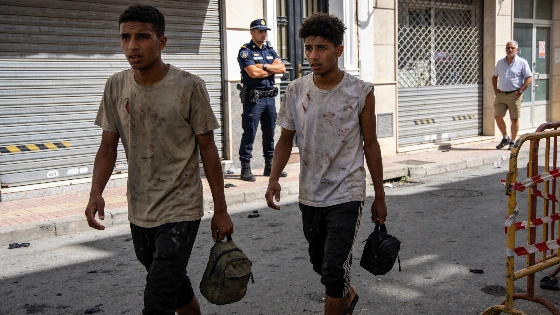
Despite official claims, many migrants are still in Ceuta. Security forces and locals work to restore order after the recent surge. Isolated incidents and uncertainty persist across the city.
Ceuta is facing ongoing disruption after more than 50,000 migrants entered the city in recent days, overwhelming local infrastructure and security. While authorities claim that most have been returned to Morocco, significant numbers of migrants—mainly from North Africa—remain scattered throughout the city and its neighborhoods. The city center, heavily guarded by police, still sees groups of migrants moving through the streets, many visibly exhausted and searching for food or a way to contact family members.
Residents report a dramatic shift in daily life. Although the initial mass gatherings have subsided, the presence of migrants is still evident, especially in areas with less police oversight. In neighborhoods such as Manzanares, El Polígono, and Villa Jovita, migrants have sought to avoid detection, prompting some locals to organize informal patrols and set up makeshift barriers to prevent access. These measures aim to deter incidents, but isolated altercations have occurred, including serious disputes among migrants and clashes near the Centro de Internamiento de Extranjeros (CETI), which remains closed and over capacity.
On Friday night, the National Police intervened at the CETI after hundreds of migrants gathered at its entrance, hoping to gain access. According to Europa Press, tensions escalated, forcing staff to seek shelter inside until police dispersed the crowd. Only women and children have been allowed entry as an exception. Elsewhere, fights have broken out, including a stabbing near Paseo de la Marina Española that heightened anxiety among residents. Many locals spent the previous day indoors, with most businesses shuttered to prevent looting. Supermarkets and food shops that stayed open saw long queues throughout the day.
As the city attempts to return to normal, the silent movement of migrants toward the border continues, especially along routes like Paseo Alcalde Sánchez Prados and Plaza de la Constitución. However, many remain in Ceuta’s outlying districts, where police presence is thinner. The situation remains tense, with uncertainty about how long it will take to fully restore order. This crisis follows a pattern seen in previous emergencies, such as the one described in reports of earlier mass crossings into Ceuta, highlighting the city’s ongoing vulnerability to sudden surges in irregular migration.
Ceuta, with a population of 83,000, has faced repeated challenges managing large-scale arrivals. The CETI has long operated at or beyond capacity, and local authorities have struggled to balance humanitarian needs with public order. Spain’s central government has increased security deployments, but the effectiveness of the so-called “operation retorno” remains in question as many migrants continue to evade repatriation. The events have reignited debate over border management and the adequacy of existing facilities, underscoring the persistent pressures on this strategic enclave at the edge of Europe.