China and the EU prepare for a high-stakes meeting in Brussels amid rising trade tensions. New legal measures and supply chain concerns dominate the agenda. Both sides seek to defend key economic interests.
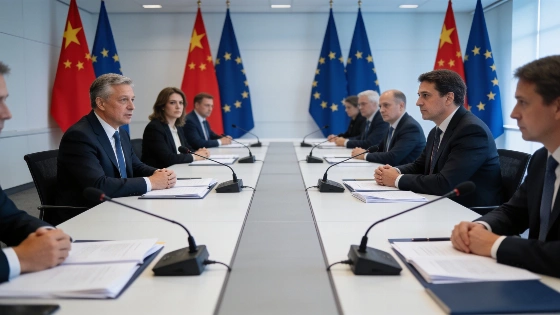
China and the European Union are set for a critical meeting in Brussels, with trade imbalances and strategic resources at the center of a growing dispute. The talks, scheduled between Chinese Commerce Minister Wang Wentao and European Trade Commissioner Maros Sefcovic, come as the EU adopts a tougher stance on Chinese imports and market practices. The outcome could shape the future of economic relations between two of the world's largest trading blocs.
Brussels has recently shifted its approach, accelerating the use of trade defense tools and considering new instruments to address what it calls an unsustainable relationship. Imports from China have surged by 45% in recent years, contributing to an annual trade deficit of around 360 billion euros for the EU. European officials link this gap to Chinese subsidies, overcapacity, and persistent barriers to accessing the Chinese market.
In response, Beijing has strengthened its legal framework to shield its industrial supply chains from external pressures. A new regulation from China's Ministry of Commerce outlines how the country will investigate and counteract discriminatory measures imposed by other nations. The rules allow for countermeasures such as trade restrictions, special tariffs, and sanctions targeting entities or individuals, reinforcing China's ability to protect its economic interests.
One of the most contentious issues is China's dominance in rare earths and other critical materials. China controls about 60% of global rare earth production and nearly 90% of processing, making it a vital supplier for sectors like electric vehicles, renewable energy, defense, and semiconductors. The EU relies on China for roughly 98% of these materials and over 90% of other strategic inputs. To reduce this dependency, Brussels has set targets for 2030, including extracting 10% of critical raw materials within the EU and limiting reliance on any single country to 65%.
The rivalry extends into technology. The EU, Germany, and the Netherlands have joined Pax Silica, a US-led initiative to strengthen AI supply chains, including semiconductors and critical minerals, as competition with China intensifies. Meanwhile, Beijing is promoting a narrative of "Oportunidad China 2.0," presenting its industrial capacity as a source of affordable products and green transition, countering European fears of a "China shock 2.0"—a new wave of high-value Chinese exports that could pressure European manufacturers.
European frustration is mounting. Jens Eskelund, president of the EU Chamber of Commerce in China, recently described a growing sense in Europe of being "cheated," warning that the old economic framework with Beijing no longer works for the EU. Academic Ding Chun from Fudan University attributes Europe's anxiety to a loss of industrial advantage and overreliance on traditional sectors, while also noting the impact of the Ukraine war and shifting US policy. This has led Brussels to erect what some see as a "protective wall" against China.
These tensions are not isolated. Across Europe, political and economic debates increasingly focus on how to respond to external pressures and safeguard strategic sectors. The current standoff in Brussels echoes broader concerns about global competition and the future of European industry. Similar political deadlocks and high-stakes negotiations have been seen elsewhere, such as in Andalusia, where last-minute talks between regional leaders and political parties have highlighted the challenges of reaching consensus in times of uncertainty.
According to EFE, the Brussels meeting will test both sides' willingness to compromise and adapt to a rapidly changing global landscape. The outcome could influence not only trade flows but also the strategic direction of European and Chinese industry in the years ahead. For Spain and other EU countries, the stakes include access to essential materials, the resilience of supply chains, and the ability to compete in advanced technologies. As the world economy becomes more fragmented, the decisions made in Brussels may set important precedents for future international negotiations.