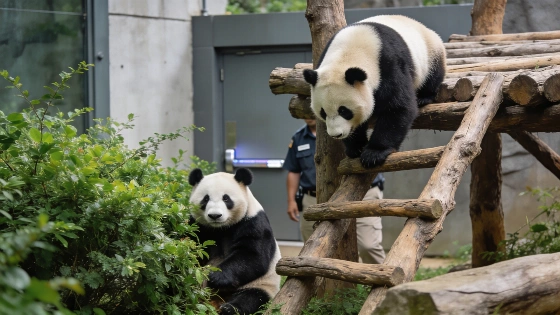
China will send two giant pandas to Atlanta Zoo after Xi Jinping announced the move before Donald Trump. The deal brings back a long-running part of Beijing's foreign policy.
The two pandas are named Ping Ping and Fu Shuang. According to Reuters, they will come from the Chengdu Research Base of Giant Panda Breeding and are due to reach Atlanta Zoo in the coming days.
Their arrival follows a new 10-year cooperation agreement signed in April by the China Wildlife Conservation Association and Zoo Atlanta. This is not a one-off state donation. The animals will enter the United States under a formal arrangement built around bilateral friendship and Chinese soft power.
The animals mattered.
Atlanta now joins a practice often called "diplomacia del panda". China treats giant pandas as a national treasure and has used them as highly visible representatives during important moments in its foreign relations. Their presence in a foreign zoo also creates a formal link between institutions and governments.
Xi called the pandas "envoys of friendship" and described their arrival as good news. His words point to the symbolic role the transfer plays in US-China relations.
Ping Ping and Fu Shuang are due to come from the Chengdu Research Base of Giant Panda Breeding, one of China’s major panda breeding and conservation centres, rather than being presented directly as a state gift.
The arrangement is more commercial and regulated than the word "diplomacy" suggests. Zoo Atlanta previously housed pandas from 1999 to 2024. The group included Lun Lun and Yang Yang, whose seven cubs were born during their stay.
The return follows a period when the panda-loan programme had stalled as relations between Beijing and Washington worsened, according to the Associated Press.
The return took time.
Since 1984, Beijing has replaced permanent gifts with long-term loan or lease agreements. Receiving zoos pay annual fees of several hundred thousand dollars. Contracts generally last about ten years.
Any cub born during the agreement remains the property of the People's Republic of China. Beijing therefore keeps control of the animals and the cooperation tied to them.
Reuters traces the modern US-China tradition of panda diplomacy to 1972, when China sent a pair of pandas to the United States after President Richard Nixon’s visit. The practice later shifted from permanent gifts to long-term agreements, formalising China’s ownership and institutional control.
The practice began in a different form. In 1941, Soong Mei-ling, known as "Madame Chiang" and the wife of Chiang Kai-shek, organised the dispatch of two pandas to the Bronx Zoo.
The gesture thanked the United States for military and economic assistance to China. At the time, China was under siege by Japan.
During the Cold War, the Communist Party government expanded the practice. Between 1957 and 1983, China sent 24 pandas to nine countries. They included the USSR, the United States, the United Kingdom and the Republic of Korea.
The animals became chosen symbols of friendship during a period when international alignments carried direct political weight.
Spain has its own long record with this form of state-to-state animal exchange. The relationship formally began in 1978 after King Juan Carlos and Queen Sofía made an official visit to China. The trip came before the arrival of the first pair as a gift from Xiaoping.
Four years later, Madrid Zoo saw the birth of Chulín, the first giant panda born in captivity in Europe. Chulín became a national zoo icon.
Madrid's current arrangement began after Bing Xing and Hua Zui Ba returned to China with their cubs born in the Spanish capital. In April 2024, the city received a new pair, Jin Xi and Zhu Yu, under a cooperation agreement between the China Wildlife Conservation Association and Madrid Zoo.
The pair is scheduled to remain in Madrid for the next decade. The agreement includes an option to extend the arrangement.
That Spanish case helps explain the Atlanta deal. This is not a one-off spectacle. It is a long-term system built around loans, breeding rights, payments and institutional cooperation.
The pandas draw public attention. Beijing still controls the framework and keeps Chinese ownership throughout the process.
Official Chinese statements reported by CGTN and other outlets also connect these agreements to species conservation, biodiversity protection and international cooperation.
The pair heading to Atlanta carries a clear political message. China is still using a highly popular national symbol to keep bilateral ties visible. It also retains control over the terms.
The method changed. The purpose did not.