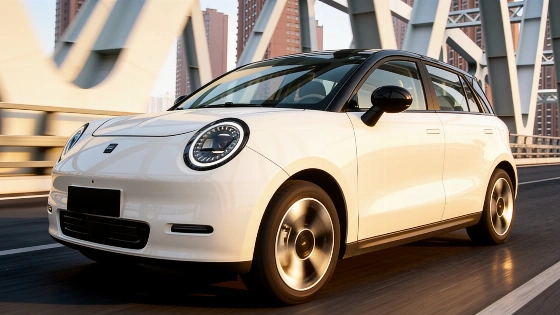
The historic Santana Motors factory in Linares is set to produce the JAC E30X, a compact Chinese electric car expected to cost under €20,000. This move brings new life to the plant and could reshape Spain’s EV market.
The assembly lines at the Santana Motors plant in Linares, Jaén, are about to see a dramatic revival. After years of uncertainty, the factory will soon be home to not just the new Santana 400 and Cajal models, but also the JAC E30X—a compact Chinese electric car designed to undercut the €20,000 price barrier in Spain.
This transformation is the result of a strategic partnership between Santana Motors and Chinese manufacturers BAIC and JAC Motors. The first wave will see the Santana 400 and Cajal roll out of Linares, both based on proven Chinese platforms: the Dongfeng Z9 for the 400 pick-up and the BAIC BJ40 for the Cajal SUV. Both models will be assembled using the SKD (semi-knocked down) method, with major components shipped from China and final assembly completed in Spain.
JAC E30X: A New Player in Spain’s EV Market
The real game-changer, however, is the JAC E30X. This B-segment electric hatchback is already available in markets like Norway and Switzerland, but local production in Linares will allow it to bypass the EU tariffs imposed on Chinese-made EVs. By assembling the E30X in Spain, JAC Motors can offer a competitive price while meeting European requirements for local manufacturing—a strategy increasingly adopted by Chinese automakers seeking a foothold in Europe.
Measuring 4,025 mm in length, 1,770 mm in width, and 1,560 mm in height, the E30X is sized to compete directly with popular models like the Seat Ibiza and Renault Clio. Unlike its European rivals, the E30X is fully electric, powered by a 95 hp motor delivering 135 Nm of torque. Its 41 kWh lithium-ion battery promises up to 293 kilometers of range on a single charge, and supports 60 kW DC fast charging for added convenience.
In some markets, the E30X is also offered with a more powerful 135 hp motor and a larger 51.5 kWh battery, extending its range to 374 kilometers (WLTP). While it remains to be seen which versions will reach Spanish showrooms, all variants feature a five-seat interior and a 310-liter boot, along with a floating central touchscreen and a digital driver’s display.
Features and Technology
The E30X comes well-equipped for its price point. Standard features include intelligent LED headlights, a heat pump climate system, DAB radio, mobile connectivity, Bluetooth, electric windows, power-adjustable mirrors, a power driver’s seat, 16-inch alloy wheels, and synthetic leather upholstery. Safety and driver assistance systems are also comprehensive, with adaptive cruise control, traffic sign recognition, pre-collision warning, lane keeping assist, rear-view camera, autonomous emergency braking, electronic parking brake, and hill start assist all available.
Buyers can opt for higher-spec versions with extras such as heated front seats, ambient LED lighting, a Hi-Fi sound system, panoramic glass roof, power-folding mirrors, a 540º camera system with transparent chassis view, rear air vents, and a cooled glovebox in the center armrest.
Competitive Pricing and Market Impact
Official Spanish pricing for the JAC E30X has not yet been announced, but in Norway the model starts at €19,850. With the potential to benefit from Spain’s new Plan Auto+ incentives, the E30X could become one of the most affordable electric cars on the market. This approach mirrors the strategy of other Chinese brands entering Spain, such as XPeng, whose L03 SUV is also targeting local buyers with aggressive pricing and European assembly, as detailed in this recent analysis.
The decision to produce the JAC E30X in Linares marks a significant shift for the region’s automotive industry. It not only revives a historic Spanish factory but also positions Spain as a key player in the evolving European EV landscape. As more Chinese brands localize production to avoid tariffs and meet demand, Spanish consumers could see a wider range of affordable electric vehicles in the coming years.
For context, Spain remains one of Europe’s largest car producers, but has lagged behind in domestic EV adoption. Initiatives like this, combined with government incentives, may accelerate the transition to electric mobility and help secure jobs in regions hit hard by industrial decline.