
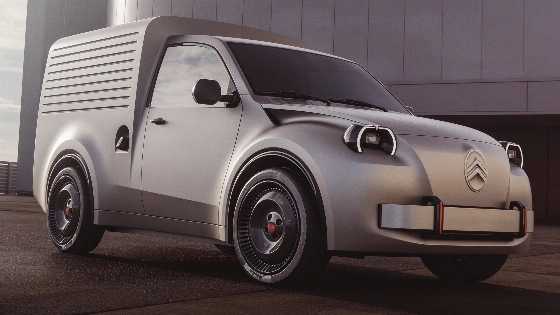
At the Paris Motor Show 2026, Citroën showed an electric study of its 2CV work van, first launched in 1951. The passenger-car 2CV Concept is planned for 2028; the van has no confirmed production plan.
At the Paris Motor Show 2026, Citroën showed a van with no disclosed production timetable or technical figures.
The electric concept revives the 2CV Fourgonnette, but Citroën has confirmed no short-term plan to sell it. The company’s announcement calls the vehicle a design study, created out of passion. It does not present the van as a near-term production model.
The passenger-car 2CV Concept is scheduled for a market launch in 2028. The Fourgonnette remains a study. Citroën describes it as a modern take on simple, practical mobility for professionals, but has made no production commitment. Battery capacity remains undisclosed. So do range and power. The company has also provided no payload figures or dimensions. Charging time and price are unknown.
The original 2 CV Fourgonnette was produced from 1951 to 1978, giving Citroën’s new study a link to more than two decades of commercial 2CV history.
The van’s history has a distinct Spanish chapter. Citroën Hispania opened its Vigo factory in 1958, and the first model to leave the assembly line was the commercial 2CV. That gave the vehicle a local industrial connection as well as a French one. A Spanish motoring-history account also recounts the model’s role in the country.
The original van entered service in 1951, two years after the passenger 2CV. Initially called the 2 CV AU, it could carry up to half a tonne while keeping the small car’s air-cooled twin-cylinder engine and suspension. Its compact size suited city streets, and it could handle unpaved roads. Tradespeople put it to work. Shopkeepers used it for deliveries, alongside professional delivery workers.
According to Carscoops, the concept uses the front section of the new 2 CV Concept, replacing the rear passenger area with a squared-off cargo compartment. Access is shown through rear barn doors and a side-opening panel.
In Spain, the van became familiar in grey. Correos y Telégrafos and the Compañía Telefónica Nacional de España used it, as did businesses and independent professionals.
Citroën chief executive Xavier Chardon has described the original as part of everyday life, valued for its simplicity and ingenuity. In remarks reported by Citroën and Carscoops, he said the designers wanted to reinterpret those qualities and the vehicle’s accessibility in electric form. The new study aims to recapture that character, but its commercial future remains unconfirmed.
The Fourgonnette draws a clear line back to a work vehicle used in France and Spain. Its status today is equally clear: Citroën has announced no production timetable for the van.