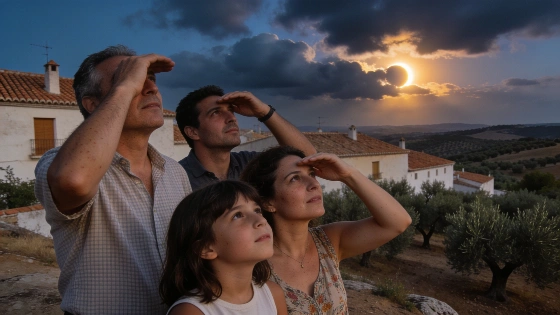
On August 12, cloud cover could block eclipse views in many Spanish towns. Updated forecasts show where skies will be clear or cloudy. The latest data highlights key risks for observers.
With the solar eclipse set for August 12, updated meteorological forecasts reveal that low cloud cover may disrupt visibility across much of Spain. The latest high-resolution data, released Tuesday morning, indicates that while most municipalities are expected to have favorable conditions, certain areas could face significant cloud-related obstacles, especially near the horizon where the sun will set.
Forecasts combine three advanced models: the ECMWF's cloud cover projections, AEMET's HARMONIE-AROME high-resolution hourly updates, and the ECMWF's AIFS artificial intelligence model, which details cloud altitude. This combination allows meteorologists to assess not only the presence of clouds but also their height—an essential factor since the eclipse will occur with the sun low in the west-northwest sky, just before sunset. Low clouds, which are denser and closer to the ground, pose the greatest risk of blocking the view, while high clouds such as cirrus are thinner and often allow sunlight to pass through.
The interactive map, updated every few hours, provides a municipality-by-municipality breakdown of expected cloud cover at 20:00 on Wednesday. It also indicates the direction observers should look to maximize their chances of seeing the eclipse. According to the latest figures, 86% of Spanish municipalities are forecast to have favorable conditions for viewing, though the eclipse will be total only within a specific band.
In addition to cloud cover, local topography can also obstruct the view. The map includes relief data to help residents identify potential obstacles on the horizon. This is particularly relevant for those in regions where hills or mountains may block the low sun, even if the sky is otherwise clear.
Weather conditions can change rapidly, and forecasts are updated frequently to reflect the latest data. For those planning to travel to optimal viewing locations, it is advisable to monitor updates closely. In some regions, recent severe weather has already impacted public events, as seen when authorities in Valencia issued orange alerts for storms and hail, prompting emergency measures and warnings about strong winds and flooding. Details on these weather alerts can be found in the report on recent emergency weather measures in Valencia.
Spain's meteorological agency AEMET plays a central role in providing these forecasts, using a grid resolution of just 2.5 kilometers for precise local predictions. The integration of artificial intelligence models further refines the outlook, especially for events like eclipses where both cloud type and altitude are critical. For residents and visitors hoping to witness the eclipse, understanding these forecasts is essential for planning. The combination of cloud cover, horizon obstacles, and rapidly changing weather means that flexibility and up-to-date information are key to a successful viewing experience.
Solar eclipses are rare events in Spain, and the next opportunity for such widespread visibility may not occur for several years. The August 12 eclipse is expected to draw significant public interest, with many municipalities preparing for increased activity. However, as recent weather disruptions have shown, local conditions can change quickly, and both cloud cover and terrain must be considered when choosing a viewing spot. For the most accurate and current information, residents are encouraged to consult official meteorological sources and local authorities as the event approaches.