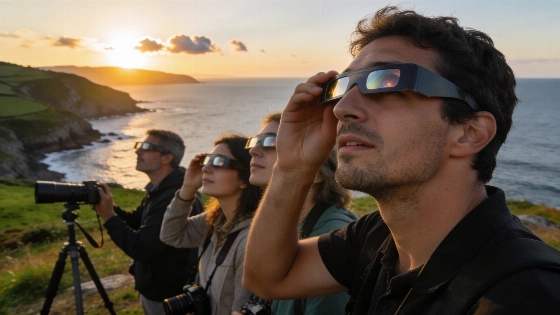
Spain prepares for a rare total solar eclipse, but cloud forecasts remain uncertain, especially for the northern coast. Aemet will launch a daily special forecast with interactive maps to help viewers plan.
Spain is set to witness its first total solar eclipse in over a century, but the prospect of clear skies remains in doubt for much of the northern coastline. While current forecasts suggest stable, anticyclonic weather for most of the country, meteorologists warn that cloud cover could still disrupt visibility in key regions such as Galicia and the Cantabrian coast.
The Agencia Estatal de Meteorología (Aemet) has announced it will release a dedicated daily forecast for the eclipse, starting Friday. This special bulletin will include an interactive cloud viewer and detailed maps highlighting the best locations for observation. The forecast will focus not only on cloud cover but also on temperature, rain probability, wildfire risk, and any adverse weather warnings as the event approaches.
According to Aemet spokesperson Rubén del Campo, reliable predictions for cloud conditions are only possible within a three-day window. Attempting to forecast specific cloud patterns for the eclipse date more than five days in advance is, as he puts it, no more accurate than a broad climatological study. Del Campo notes that while the outlook currently appears favorable, the position of the anticyclone will be decisive—if it shifts, even slightly, it could bring unexpected cloud or even storms to the north at the critical moment.
Benito Fuentes, another Aemet meteorologist, has published a color-coded risk map on X, showing most of Spain in green, indicating a high chance of clear skies. The Balearic Islands also appear favorable, while the Canary Islands may see fewer clouds on their southern sides. However, a narrow blue zone suggests possible afternoon cloud development in some eastern areas, and the entire Galician and Cantabrian coast is marked in red, reflecting high uncertainty rather than a definite risk of poor weather.
Weather models currently point to two similar scenarios: the most favorable conditions are expected in the central-western peninsula, while the eastern half could see typical convective clouds over mountain ranges like Cazorla and the Pyrenees. The key unknown is whether these clouds will develop into storms or persist long enough to affect eclipse viewing.
The greatest uncertainty remains precisely where the eclipse’s path of totality enters Spain—along the Galician and Cantabrian coasts. Here, model updates frequently alternate between predicting cloud cover and clear skies, making planning especially challenging for those hoping to witness the event in these areas.
For those planning their viewing spot, Fuentes recommends checking the forecast not just for their immediate location, but for areas 20 to 70 kilometers to the west. At the time of maximum eclipse, around 20:30, the sun will be low on the horizon, so clouds far to the west could block the view even if the sky overhead is clear.
In addition to clouds, other factors such as Saharan dust (calima) or wildfire smoke could reduce visibility, though they are less likely to completely obscure the sun. As Spain prepares for this rare astronomical event, the evolving weather situation is being closely monitored. For comparison, recent weather disruptions in other European regions, such as the storms and heatwaves that affected Switzerland earlier this summer, have shown how quickly conditions can change—see the report on severe weather impacts in Switzerland.
The last total solar eclipse visible from mainland Spain occurred in 1912, making this event a once-in-a-lifetime opportunity for many. The path of totality will stretch from Galicia to the Balearic Islands, but only those in the right place at the right time—and with a clear western horizon—will experience the full spectacle. Aemet’s daily updates and interactive tools are expected to play a crucial role in helping residents and visitors make the most of this historic moment.