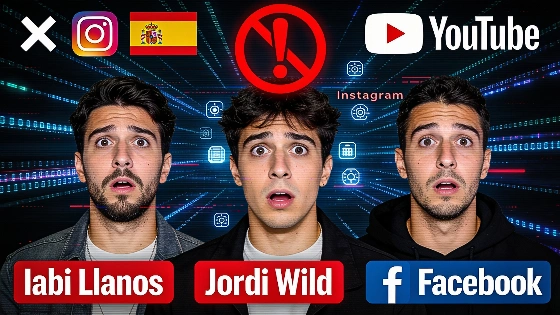
Spain’s CNMC has fined Ibai Llanos, Jordi Wild and Nachter over €4,000 in total. The penalties address failures in ad disclosure, child protection and medicine promotion on social media. The move signals stricter oversight for digital creators.
Spain’s National Commission on Markets and Competition (CNMC) has imposed fines exceeding €4,000 on prominent influencers Ibai Llanos, Jordi Wild and Nachter, citing serious breaches of audiovisual advertising and child protection rules. The sanctions, announced this week, mark a significant escalation in regulatory scrutiny of digital content creators operating on major social platforms.
The CNMC’s investigation found that all three influencers failed to comply with the General Audiovisual Communication Law, specifically regarding clear advertising identification, safeguarding minors, and the promotion of medicines online. Each case involved distinct violations, but all were classified as serious infractions under Article 158.31, which applies to so-called “users of special relevance” (UER) in the digital sphere.
Ibai Llanos was fined €710, reduced to €568 for early payment. The regulator determined that several videos posted on X (formerly Twitter) to promote the event La Velada featured commercial brands without the required visual cues to distinguish advertising from editorial content. Jordi Wild received a penalty of €1,543.44, lowered to €1,241.95 after prompt settlement. His YouTube channels, @ElRinconDeGiorgio and @dwt_fighting, broadcasted extreme contact fight content linked to the Dogfight Wild Tournament without proper age ratings, warnings, or filters to restrict access by minors.
Nachter faced the largest fine: €1,779.94, reduced to €1,067.96 after acknowledging responsibility and paying early. The CNMC found that his Instagram and Facebook profiles promoted over-the-counter cold remedies without the mandatory health warnings or explicit advertising labels required by Spanish law for medicinal products.
All three decisions were approved by the CNMC’s Regulatory Supervision Board, with one dissenting vote. The regulator emphasized that legal obligations fall directly on professional content creators, regardless of the technical tools or policies of the platforms they use. This approach reflects a broader European trend toward holding individual influencers accountable for compliance, not just the platforms themselves. In a related move, the CNMC recently awarded a €32,800 contract to Portuguese analytics firm Primetag to automate monitoring of influencer videos for undisclosed commercial placements, echoing similar enforcement actions at the EU level—such as the record fine imposed on AliExpress for failing to control illegal sales, as detailed in this recent report.
Spanish law now requires that advertising be directly and visibly marked within audiovisual content, as many viewers do not read accompanying text descriptions. The CNMC has clarified that vague terms like “collaboration” or “brand ambassador” do not meet transparency standards, and the obligation to disclose applies even if there is no direct payment from the advertiser.
Before these fines, the CNMC had issued warnings to other creators—including Lola Lolita, Peldanyos, Sofía Suescun, Tamara Gorro and Samantha Vallejo-Nágera—following complaints from the Association of Communication Users (AUC). Those earlier cases, which involved undisclosed promotions of financial, food, and fashion services, did not result in penalties as they predated the regulator’s current interpretative guidelines.
Spain’s tightening of digital advertising rules mirrors a wider European push for transparency and consumer protection in online media. The CNMC’s actions highlight the growing expectation that influencers must adhere to the same standards as traditional broadcasters, especially when their content reaches large audiences or involves sensitive sectors like health and finance. As regulatory oversight increases, both creators and brands face greater pressure to ensure full compliance with advertising and child protection laws.