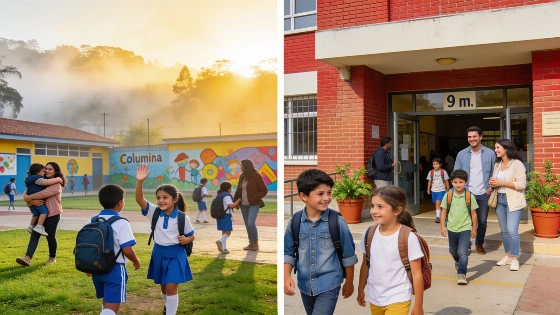
Viviana, a Colombian mother living in Spain, has drawn attention to the unexpected contrasts between Spanish and Colombian schools. Her observations on schedules, uniforms, and daily routines have resonated with many families, highlighting how everyday details can shape the school experience.
When Viviana moved from Colombia to Spain with her three children, she expected some adjustments. But it was the everyday routines of Spanish schools that truly surprised her—and her candid account has since prompted a wave of discussion among parents from both countries.
Viviana, who shares her experiences on TikTok as @vivianaemprende1, outlined four key differences that stood out since enrolling her children in Spanish schools. Her video quickly gained traction, amassing over 42,000 views in less than a week and drawing responses from families with similar stories.
Start Times: A Shift in Family Life
The first shock for Viviana was the school schedule. In Colombia, she recalls, classes began as early as 6:00 or 6:30 in the morning. In Spain, her children start their day at 9:00—a change that, she notes, has a significant impact on family routines. While Viviana is careful to point out that her experience may not reflect every school, the later start time is a common feature in many Spanish cities.
Uniforms: From Everyday Essential to Occasional Requirement
Uniforms were another point of contrast. In Colombia, wearing a school uniform was the norm and served as a clear marker of each student's school identity. In Spain, Viviana found that uniforms are far less common, typically reserved for private schools—and even then, not always mandatory. Some viewers clarified that uniforms are also used in certain semi-private (concertado) schools, but overall, the practice is much less widespread than in Colombia.
Recess: No Pocket Money for Snacks
Perhaps the most unexpected difference for Viviana was the approach to recess. In the Spanish schools her children attend, students do not bring money to buy snacks or treats during breaks. This stood in stark contrast to her memories of Colombia, where it was normal for children to purchase food during recess. The discussion extended to school cafeterias, with some parents noting that while lunch services are available, they often come at an extra cost—though subsidies and scholarships can help, depending on the region and family circumstances.
Nap Time: A New Routine for the Youngest
Viviana also highlighted the practice of scheduled naps for younger children. Her two- and four-year-olds nap around 1:00 or 2:00 p.m., a routine shaped by the longer school day that often stretches until 5:00 p.m. This was unfamiliar territory for Viviana, as naps were not part of the school day in Colombia.
Viviana's observations have encouraged other families to share their own experiences, revealing just how much school routines can vary not only between countries, but even from one city or institution to another. Her story underscores how small details—like start times, uniforms, and snack habits—can shape the daily lives of students and parents alike.
According to Talent24h, these differences reflect broader cultural and institutional contrasts between Spain and Colombia. While Viviana's account is personal, it has opened a window into the ways education systems adapt to local customs and family needs.