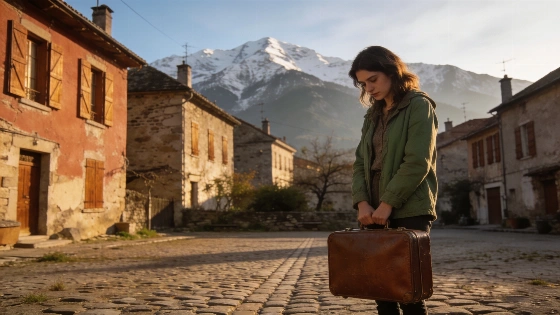
After a year in a remote Pyrenean village, Sandra is leaving behind rural solitude and economic uncertainty. The young content creator will move to Valladolid, seeking stability and a fresh start with her partner after losing both income and companionship.
Sandra, a 28-year-old video editor and content creator, is packing up her life in a tiny Pyrenean village after a year that tested both her finances and her emotional resilience. Drawn by the promise of peace far from Madrid’s relentless pace, she found herself instead confronting the harsh realities of rural isolation and unstable freelance income.
Her move to the Aragonese Pyrenees was meant to be a reset—a chance to build a quieter, more intentional life. The village, home to fewer than 100 residents, offered tranquility but little in the way of economic opportunity. Sandra’s work as a freelancer brought in unpredictable earnings, with some months yielding as little as €200. Meanwhile, fixed costs—€450 in rent, utilities, accounting fees, and Spain’s mandatory self-employment quota—quickly eroded her savings.
“I can’t afford to keep paying rent on my own. My income just isn’t stable,” Sandra explained to her YouTube audience, highlighting a dilemma familiar to many young Spaniards: even outside the big cities, financial independence remains elusive without steady work or family support. The economic pressures of self-employment, especially in remote areas, can make rural dreams unsustainable.
Loss and Loneliness
Financial strain was only part of the story. The sudden death of her dog Jack, Sandra’s closest companion in the village, left a void that made daily life increasingly difficult. What once felt like peaceful solitude soon became an isolating burden. “Emotionally, I’m not well here, and financially, I’m not either,” she admitted, underscoring how intertwined economic and emotional stability can be in such settings.
Despite describing her rural experience as “incredible,” Sandra acknowledged the limitations of small-town life: scarce services, few job prospects, and the absence of a close support network. The loss of Jack amplified these challenges, making it clear that her well-being required a change of environment.
New Beginnings in Valladolid
Sandra’s next chapter will unfold in Valladolid, where her partner lives. The move is both a personal and professional reset. She is considering new career paths—possibly studying psychology, training in editorial work, or launching a craft-based project to secure more reliable income. Her digital presence will continue, with her podcast rebranding as El rincón de sobrepensar, reflecting her evolving perspective.
Her story is not unique. The difficulties of sustaining a rural lifestyle—especially for young freelancers—echo broader trends in Spain, where the dream of escaping city life often collides with economic and social realities. As Sandra prepares for her move, her experience resonates with others seeking balance between personal fulfillment and practical necessity.
Stories of rural reinvention are not new in Spain. For example, the transformation of Pedraza Castle into a cultural hub by Santiago Segura and José Mota, as detailed in this report on a Segovian fortress revival, shows how some are finding ways to breathe new life into the countryside—though not everyone has the resources or support to make such projects viable.
For Sandra, the move to Valladolid is a pragmatic step toward regaining stability. Her journey highlights the complex trade-offs facing many young Spaniards as they navigate between rural aspirations and urban realities.