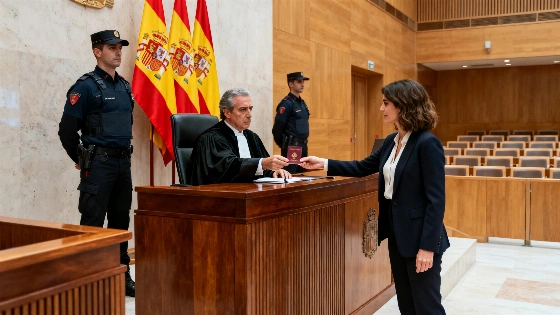
A Madrid judge has ordered Begoña Gómez, wife of the Prime Minister, to face trial for four alleged crimes. She must surrender her passport, cannot leave Spain, and is required to report to court every 15 days.
Begoña Gómez, the wife of Spain's Prime Minister, now faces a criminal trial after a Madrid judge ordered her to appear before a jury on charges including influence peddling, business corruption, embezzlement, and misappropriation. The court has imposed strict precautionary measures: Gómez must hand over all her passports, is barred from leaving the country, and is required to check in with the court twice a month. These steps reflect the court's assessment of a significant flight risk, given the potential for a prison sentence if convicted.
The decision, issued by Judge Juan Carlos Peinado, also affects Cristina Álvarez, Gómez's advisor at La Moncloa, and businessman Juan Carlos Barrabés. Álvarez faces the same charges as Gómez, while Barrabés is accused of influence peddling and business corruption. The judge's order marks the formal end of the investigation phase and prepares the case for transfer to the Provincial Court, which will determine whether the trial proceeds before a jury or a professional tribunal.
Judge Peinado justified the travel restrictions by citing the risk that, if convicted, the accused could face a prison term exceeding two years—making a suspended sentence unlikely. He dismissed the defense's argument that Gómez's constant police protection as the Prime Minister's spouse would prevent her from fleeing, noting that such protection is temporary and could be withdrawn if her husband's term ends. The judge also pointed out that police officers could, in theory, assist in an escape, whether by their own initiative or under orders.
Gómez is now prohibited from applying for new passports of any nationality, whether ordinary or diplomatic. The ban on leaving Spain has been communicated to all border posts and airports, both civilian and military. She must report to Madrid's Court No. 41 once in each half of every month. The same conditions apply to her advisor, Álvarez, due to her close association and similar risk profile. No precautionary measures were imposed on Barrabés, as the popular prosecution did not request them.
The final decision on whether the trial will be held before a jury or a professional court rests with Section 23 of the Madrid Provincial Court, which is still considering appeals from the defense and the public prosecutor. If these appeals are rejected, the trial will move forward as planned. In Spain, cases involving public officials and allegations of corruption often attract significant public and media attention, especially when they involve figures close to the government. The outcome of this case could have broader implications for the legal treatment of high-profile individuals in the country.