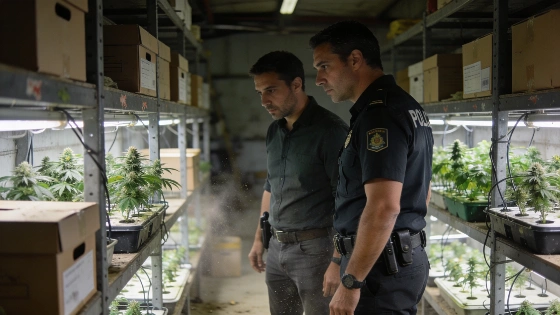
Growshop Network Exposed in Spain: €80 Million Turnover, Owners Arrested. Catalonia police and the Civil Guard have detained two entrepreneurs who ran a growshop network. The stores supplied infrastructure to six criminal organizations. The court authorized the arrests and the temporary closure of the business.
A large-scale investigation in Catalonia has concluded, during which the police and the Civil Guard detained two administrators of a growshop network supplying equipment for marijuana cultivation. Over seven years, four stores controlled by these entrepreneurs provided infrastructure for at least six criminal groups, and the network's total turnover reached 80 million euros. The court ordered that both suspects be taken into custody and temporarily suspended the activities of the stores.
According to the investigation, the stores sold fertilizers, lamps, filters, and air conditioners necessary for large marijuana plantations. Although such products are legal, their mass supply to anonymous clients enabled criminal organizations to create industrial-scale plantations. Since 2019, 80 million euros have passed through the network; however, only 13 million were officially declared. The remaining funds, according to police, came from drug dealers in cash and were laundered through fictitious accounts and transfers between companies.
During searches in Tarragona and Granada, more than 90,000 euros in cash were seized, some of which was hidden in secret compartments. Investigators note that the shop owners carefully concealed their activities: truck drivers were given false addresses, and goods were unloaded in closed warehouses with the shutters drawn. The entire scheme was based on trust between suppliers and criminal groups — if equipment was confiscated by police before use, the entrepreneurs provided a new set with no additional guarantees.
According to police, the network's clients were predominantly Albanian groups, while the shops themselves belonged to Spanish citizens. Authorities emphasize that a growshop can operate legally only when selling retail for personal use. In this case, it involved industrial-scale volumes and systematic circumvention of legislation. The case materials mention not only large sums with no explained origin, but also attempts to expand the business beyond Spain — in particular, opening a branch in Germany near the Netherlands, where the cultivation of marijuana for personal use is permitted.
The investigation became possible thanks to prolonged surveillance, wiretapping, and analysis of financial flows. According to representatives of Mossos d'Esquadra, combating such schemes is crucial to prevent criminal structures from infiltrating legitimate businesses. Similar cases have been previously detected, for example, an investigation into budget transfers to companies linked to high-profile figures, also highlights the vulnerability of the economic system to such schemes.
For reference: in Spain, growing marijuana for personal use is not prohibited; however, industrial production and distribution remain criminal offenses. Catalonia is considered one of the regions with the largest number of discovered plantations. According to police estimates, such schemes may serve dozens of criminal groups, and the turnover of the illegal marijuana market in the country amounts to hundreds of millions of euros annually.