A new film explores the tense hours before the Normandy landings. The story centers on a high-stakes weather dispute that could have changed the course of World War II. The director avoids spectacle, focusing on ethical dilemmas and human responsibility.
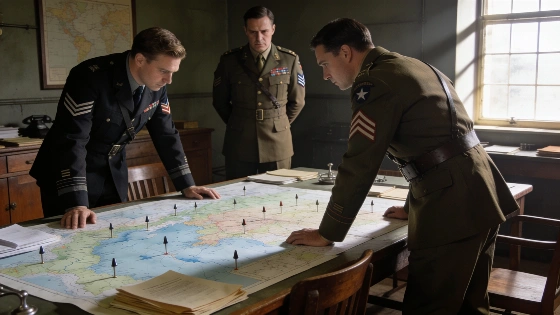
The fate of thousands once depended on a single weather report, and Anthony Maras’s new film, Tiempo de victoria, brings that tension to the screen. Instead of focusing on the beaches of Normandy, the story unfolds behind closed doors, inside the Allied command center, where a last-minute forecast could change the course of the Second World War.
Adapted from David Haig’s play Pressure and based on real events, the film follows Captain James Stagg, the British army’s chief meteorologist. With the D Day invasion approaching, Stagg must deliver a forecast that will either launch or delay the largest military operation in history. The risk is clear: a wrong call could cost lives and shift the direction of the war. According to BBC News and Radio Times, Stagg’s forecast led to the 24-hour postponement of the Normandy landings—a decision that proved vital for Operation Overlord’s success.
Filming took place at Southwick House, the actual Allied headquarters where the D-Day decision was made, adding a layer of historical authenticity to the film.
Tension rises when Stagg’s British forecast clashes with the assessment of his American counterpart. General Eisenhower, played by Brendan Fraser, insists on agreement. Both meteorologists defend their science under intense pressure, knowing the final call rests with them. The English title, Pressure, captures both the literal and moral weight of the moment. As several sources confirm, the film centers on the real dispute between Stagg and American meteorologist Irving P. Krick, whose conflicting forecasts nearly led to disaster.
Tiempo de victoria stands apart by avoiding digital effects and battlefield spectacle. Maras and co-writer Haig focus on a tightly constructed narrative, with attention to secondary characters and personal struggles. Stagg’s private doubts, Kay Summersby’s steady presence as Eisenhower’s aide, and the general’s own struggle with the human cost of his choices all add depth. Reviews from WDR and NDR note that the film keeps its focus on the psychological and ethical strain of the 72 hours before D-Day, rather than on combat scenes.
The film explores scientific rivalry and the burden of responsibility. The script looks beyond the accuracy of forecasts to the conscience of those making them. The result is a story that feels urgent and relevant, offering a rare look at the people behind historic decisions.
The film was released across European markets in September 2026, with premiere dates ranging from the 11th to the 17th depending on the country. Multiple reviews highlight that Pressure covers the critical 72-hour window before D-Day, focusing on the immense responsibility and uncertainty faced by Allied leaders.
Anthony Maras, known for Hotel Mumbai: el atentado, shows a steady hand with historical material. The direction is precise, the editing tight, and the performances—especially Andrew Scott as Stagg—are convincing. The film’s classical style and lack of artificial effects give it an authenticity that many modern war dramas lack. BBC News notes that the casting of Andrew Scott and Brendan Fraser has been widely praised for its accuracy and depth.
For anyone interested in the intersection of history, science, and personal responsibility, Tiempo de victoria is worth seeing. Its focus on leadership under pressure echoes dilemmas faced in other high-stakes situations, like those described in recent reports about border crises and decision-making under uncertainty.
Tiempo de victoria is a thoughtful and engaging addition to the genre. It shows that real heroism often comes from difficult choices made far from the front lines, and reminds viewers of the lasting importance of ethical leadership and individual responsibility in moments that shape history.