A woman with severe burns died at the Hospital Virgen del Rocío in Seville, bringing the Los Gallardos wildfire death toll in Almería to 14. Hospital sources and the Andalusian regional government confirmed her death on Tuesday. Her age and nationality had not been disclosed. She had burns over 70% of her body, was admitted in critical condition and received continuous care from intensive-care and burn specialists.
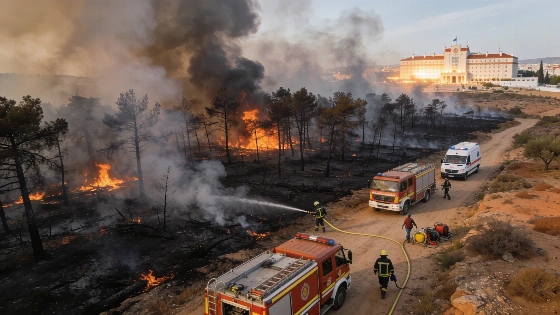
The fire broke out on July 9 and was declared fully extinguished in the early hours of July 25, after burning for 16 days. It spread toward neighboring municipalities, including Bédar, amid high temperatures and dry terrain, with strong winds adding to the danger. The fire prompted evacuations and a large emergency response. In the disaster’s initial hours, the Guardia Civil found the bodies of 12 victims. Another woman hospitalized in Almería died from her injuries on July 12. Three people rescued from the fire remained hospitalized in Seville with serious burns.
At the time of this report, the 14 deaths made the blaze Andalusia’s deadliest wildfire in recent history. Later coverage raised the final toll to 15: Lisa, a British victim rescued with her husband Simon, died of her burn injuries 19 days after the rescue. Four Guardia Civil officers carried out the couple’s rescue. Later reports also estimated that the fire burned about 7,000 hectares. The 5,200-hectare figure cited here was presented by Antonio Sanz, Andalusia’s vice president and minister for the presidency, health and emergencies, during a parliamentary session on the government’s response.
Authorities had identified 13 of the 14 victims at the time: one Spanish national and 12 foreign nationals. Three were Belgian; France and the United States each had one national among the victims. Nine of the deceased were women and five were men; all were adults. The regional government had not released details about the latest victim’s identity. Subsequent reporting described the Los Gallardos disaster as the deadliest wildfire in Andalusia’s history and renewed calls to improve prevention and coordinate emergency response. Garrucha, among the municipalities discussing preparedness after the fire, prepared a plan for responding to future catastrophes.
The handling of the emergency drew criticism from opposition parties, which called for a formal investigation. The Andalusian PSOE announced its intention to participate in the judicial inquiry led by Court Number 3 in Vera, Almería. Questions included why phase 1 of the emergency plan, designed to protect the population, was not activated until three hours after the first emergency call. By then, around 50 people had already been evacuated. There were also concerns about the failure to send an Es Alert notification, reportedly because the Bédar base station responsible for transmitting the signal had broken down. PSOE representative Rodrigo Sánchez Haro argued that several mobile operators covered the area and that their networks did not go offline until 11 p.m.
The Los Gallardos fire was part of an exceptionally severe wildfire season in Andalusia. A later analysis by La Voz del Sur, based on official campaign data, put the season’s burned area at 59,685 hectares, more than seven times the regional annual average. It found that 61% of fires remained in the initial “conato” phase, compared with an average of 79% from 2010 to 2024. The season also included the Niebla wildfire in Huelva, reported as the largest in the autonomous community’s history. For a related example of evacuation pressures elsewhere in Spain, large-scale evacuations were recently carried out in Castellón as another wildfire forced thousands from their homes.
The Los Gallardos disaster intensified debate over emergency protocols and regional response capacity, with public warnings also under scrutiny. As the judicial inquiry proceeds, attention remains on supporting survivors and examining the sequence of decisions made during the crisis. The fire also underscored the importance of specialized burn-care services, including those at Hospital Virgen del Rocío, and preparedness for fast-moving emergencies.