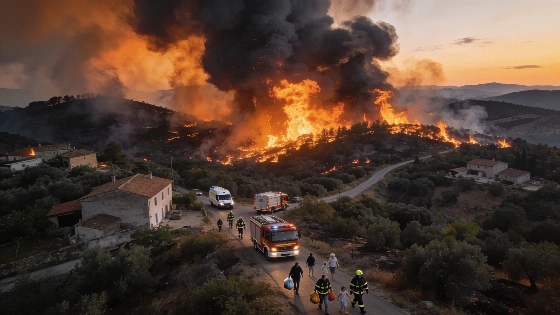
Emergency services in Castellón battled a wildfire that began near Vall d'Uixò on 25 July 2026 and triggered mass evacuations across the region. Initial emergency figures put the number of evacuees at approximately 15,000 across 15 municipalities; RTVE later reported that about 16,000 people from 18 municipalities had been evacuated. The fire spread along a 21-kilometer perimeter and, in its early phase, remained beyond the reach of containment efforts, regional authorities said. It advanced rapidly, leaving local officials and emergency teams little time to act.
Among the areas most affected were two neighborhoods in Vall d'Uixò and two in Betxí, where the rest of the population remained under confinement orders. Entire towns, including Vilavella, Artana, Eslida, Tales, Artesa (a district of Onda), Aín, Alcudia de Veo, Alfondeguilla, Sueras, Torralba, Villamalur, Fuentes de Ayódar and Chóvar, were evacuated as a precaution. On 26 July, local reporting said the fire was approaching the A-7 motorway near Betxí, bringing the emergency close to a major transport corridor. Many evacuees had been staying in second homes and later returned to their core residences; others moved to temporary shelters in sports centers in Nules, Moncofa and Onda. Another shelter was due to open in Segorbe.
Later estimates put the burned area at approximately 9,568 hectares, making the blaze close to 10,000 hectares and the third-largest wildfire in the Comunitat Valenciana in the preceding decade. About 3,688 hectares burned within the Serra d’Espadà Natural Park, roughly 12% of its total area. The fire also destroyed two nests used by Bonelli’s eagles. The Generalitat later undertook habitat recovery work in the protected area, including rebuilding the nests.
Medical teams treated several people injured in the Vall d'Uixò fire. One person received care in the burns unit at Hospital La Fe in Valencia, while six others needed emergency treatment. Three remained hospitalized for smoke inhalation at Hospital de La Plana, the regional emergency coordination center confirmed.
In a separate incident, a forest fire in the barranco del Salt de l'Aigua area of Manises, Valencia, left one person dead. Five others suffered smoke inhalation and burns and were taken to Hospital de Manises, information from the local council and Europa Press.
Authorities, including Generalitat president Juanfran Pérez Llorca and national officials such as Minister of Science, New idea and Universities Diana Morant and Government Delegate in the Comunitat Pilar Bernabé, praised the coordinated response involving security forces, local councils and emergency services. The scale and speed of the evacuations tested local resources. Officials also highlighted cooperation between state, regional and municipal bodies.
Nearly three months after the fire began, authorities had classified it as intentional, and investigators were still seeking the person responsible, RTVE reported. The criminal investigation remains separate from reports that the Guardia Civil was investigating three men over alleged forest fires in Castellón; those reports did not identify them as suspects in the Vall d'Uixò blaze. The distinction between an investigation and established responsibility remains basic to the case.
The fire formed part of an exceptionally damaging wildfire season across the Comunitat Valenciana. Levante-EMV reported 140 forest fires and outbreaks between June and September 2026. Four major “sixth-generation” fires in Vall d'Uixó, Tuéjar, Tírig and Segorbe burned approximately 11,750 hectares combined. In October, the PSPV also criticized the Consell’s wildfire-prevention policy, saying that seven of Castellón’s eight natural parks lacked a director. That criticism reflected the party’s political assessment, not a finding from an independent inquiry.
Spain has faced a series of severe wildfires in recent years, with mass evacuations becoming increasingly common during periods of extreme weather. The Castellón crisis followed similar emergencies elsewhere in the country, including events in Girona, where lockdowns were lifted after a major blaze was stabilized. For further context on how Spanish regions are managing wildfire threats and large-scale evacuations, see this report on the response to the Les Gavarres fire in Girona.
Wildfires in Spain often worsen in hot, dry and windy conditions, particularly in summer. The country has invested in better coordination between regional and national emergency services, but the scale of recent incidents continues to stretch available resources.