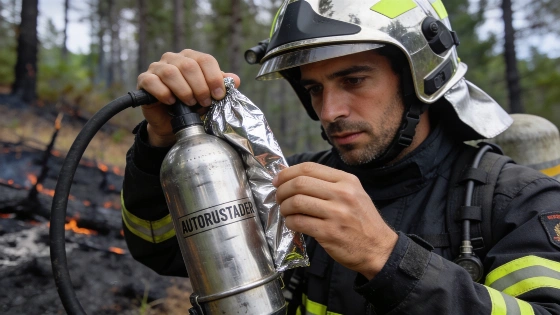
Galicia’s government has withdrawn over 2,600 emergency oxygen devices from wildfire crews after widespread defects. The recall raised urgent questions about frontline safety and official oversight during peak fire season.
More than 2,600 emergency oxygen devices meant to protect Galicia’s forest firefighters have been pulled from service after widespread defects were discovered. The recall affected nearly every unit distributed to frontline crews and was confirmed by the Xunta’s director general of Defensa del Monte, Manuel Francisco Gutiérrez, during a tense session in the regional parliament.
The devices, called autorrescatadores, are supposed to generate oxygen in life-threatening situations, such as when firefighters are trapped by flames. Instead, most of the 2,820 units purchased by the Xunta had a manufacturing flaw: their aluminized hermetic bags would inflate on their own, raising doubts about whether they could be trusted in an emergency. Gutiérrez acknowledged the problem only after repeated questioning from opposition lawmakers, admitting that the devices had to be sent back to the manufacturer for inspection and replacement. According to La Voz de Galicia, the Xunta officially returned 2,639 out of 2,820 units, a figure also reported by Quincemil/El Español and Galiciapress.
The faulty devices were replaced with an improved version featuring a valve designed to prevent contamination and possible oxygen leakage.
Despite the scale of the recall, Gutiérrez insisted the manufacturer said the defect did not make the devices unusable. He argued that replacements were handled one by one as failures were reported, and claimed that not all firefighters were left without protection at the same time. Critics were not reassured, pointing to the number of withdrawn units as evidence of a larger failure in procurement and oversight. The Xunta maintained, according to official statements cited by La Voz de Galicia, that no forest firefighter was left without an autorrescatador, as replacements were provided as soon as issues were found.
Socialist deputy Carmen Rodríguez Dacosta called the distribution of faulty equipment to wildfire crews "unforgivable." She pressed Gutiérrez on whether any brigadistas had to fight fires without the rescue devices during the recall. His vague answers only fueled accusations that the Xunta failed to protect its personnel, with Dacosta alleging that some firefighters had to buy their own backpacks to carry essential gear because of delays and shortages.
This controversy comes as Galicia faces high wildfire risk, and the reliability of emergency equipment is critical. The recall echoes broader concerns about whether Spain’s emergency services have the resources they need, as seen in other recent incidents where frontline responders struggled with equipment problems.
The issue with the autorrescatadores was that their hermetically sealed aluminized bags would spontaneously inflate, a defect the manufacturer claimed did not make the devices unusable. The incident and subsequent recall were widely covered by leading regional and national media, underlining the scale of the problem and its impact on public trust.
While Gutiérrez said new equipment is being procured, the episode has exposed a gap between official assurances and what actually happens on the ground. Firefighters—those most at risk—were left to deal with equipment failures and supply delays. The way the Xunta handled the recall raises questions about accountability and whether Galicia is truly prepared for the next wildfire emergency.