Spain’s DGT will soon mandate that nearby Guardia Civil officers respond to every V-16 beacon alert. The move formalizes a practice already common, but rising activations raise concerns about police capacity.
Spain’s Directorate-General for Traffic (DGT) is preparing a new directive that will make it mandatory for Guardia Civil de Tráfico officers to respond to every activation of the connected V-16 emergency beacon. This measure, expected to be signed imminently, aims to formalize what has already become routine practice as the number of daily alerts continues to climb. According to DGT director Pere Navarro, the intention is to ensure that drivers who use the V-16 beacon receive prompt assistance from the nearest available patrols, reflecting the agency’s focus on support rather than sanctions.
The scale of the challenge is significant. While the Guardia Civil’s traffic division officially counts around 9,100 officers, operational numbers are much lower due to shifts, leave, and other duties—leaving an estimated 6,000 agents available for patrol at any given time. This comes as the volume of V-16 beacon activations has surged: in June alone, more than 2,500 alerts were registered daily, totaling 75,000 for the month. For comparison, October 2025 saw just 6,300 activations, before the device became mandatory. Since January, monthly figures have consistently exceeded 63,000, highlighting the growing reliance on this technology.
The V-16 beacon, which must be carried in all vehicles by law, has seen widespread adoption, with DGT estimating 16 million units sold out of a total vehicle fleet of 28 million. Failure to have the device in the car results in an €80 fine. Despite this uptake, the company behind the original invention, Netum Solutions—founded by two former Guardia Civil officers—has entered insolvency proceedings, underscoring the commercial volatility in the sector.
Navarro has dismissed criticism of the measure as unproductive, describing the debate as “sterile” and noting that other European countries, including Germany, Belgium, and Portugal, have shown interest in adopting the Spanish-designed beacon. In Brussels, the device is even referred to as “la baliza española.” The DGT reports that before the V-16’s introduction, it was aware of about 8,600 monthly road incidents; that figure has now jumped to 69,000, reflecting both increased reporting and the device’s impact on emergency response protocols.
The new directive comes at a time when the Spanish government is under scrutiny for its handling of public services and resource allocation. Recent decisions, such as the approval of a €112.8 million rescue package for Tubos Reunidos following political lobbying, have sparked debate about priorities and the influence of internal contacts. Details of that case can be found in this analysis of how state aid decisions are shaped by political pressure.
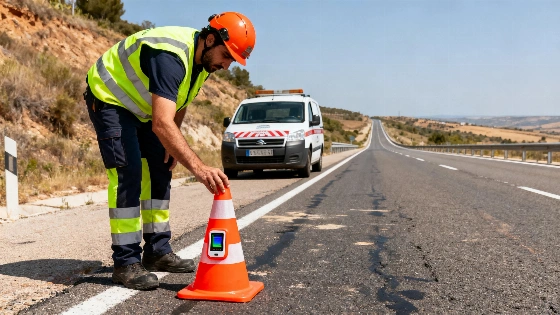
For context, the V-16 beacon is a small, portable device placed on a vehicle’s roof in the event of a breakdown or accident. It emits a flashing signal and, in its connected version, automatically transmits the vehicle’s location to emergency services. The goal is to improve roadside safety and reduce the risk of secondary accidents. The DGT’s move to formalize police response is intended to ensure that the system delivers on its promise of rapid assistance, but the strain on available officers raises questions about sustainability as usage continues to rise. The coming months will test whether the current resources can keep pace with the growing number of alerts and whether further adjustments will be needed to maintain effective roadside support across Spain.