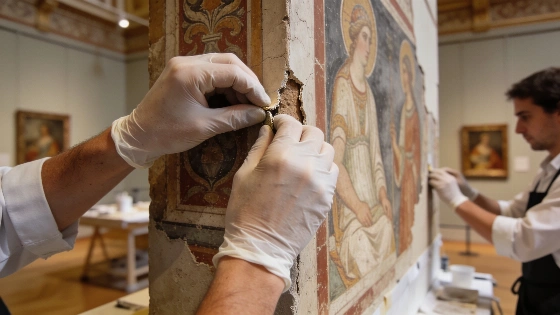
At 8.30am on Tuesday, 17 November, Aragón’s director general for Culture and Cultural Heritage, Pedro Olloqui, entered the Museu Nacional d’Art de Catalunya (MNAC) with three restorers from the regional government. They are part of the team preparing the profane paintings for transfer from room 17 to the Real Monasterio de Santa María de Sijena, with arrival expected on 2 December. The eight frescoes, transferred onto canvas, have been displayed at the MNAC since the 1990s. Removed from the monastery in 1960, they form a continuous frieze originally installed in a rectangular room between the church and cloister.
The work has begun under an agreed protocol and behind closed doors, with technical staff present. Specialists from SIT and the MNAC will take part alongside Aragón staff. The three Aragonese restorers are to act as couriers throughout the operation, including during dismantling and packing. The MNAC has said the panels are mounted on separate, flat, rigid supports, so they can be removed without cutting into or dividing them. Unlike the chapter-house murals, they suffered no direct fire damage and do not require the same pre-transfer consolidation.
The first phase is a pilot for a more complex transfer: the Sala Capitular paintings are larger and comprise 35 fire-damaged fragments. Olloqui described the room 17 works as a practical rehearsal for the future movement of that material. The MNAC has said the eight panels have substantially different conservation characteristics from the chapter-house murals.
After dismantling, technicians are due to consolidate areas where the painted layer has lifted. They will record the works’ dimensions and weight, then photograph them and assess their condition. These steps will document the paintings before transport. Aragón has said it aims to display the returned panels in the first months of 2028, after restoration and other technical work.
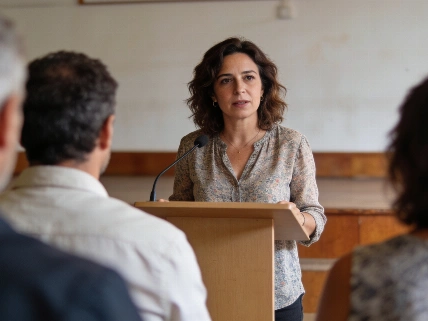
Olloqui said the Aragón delegation was received cordially by a member of the MNAC legal team before meeting museum director Pepe Serra and board president Joan Oliveras. He said Aragón had sought a working meeting with Serra to agree cooperation on implementing the court judgment, but that request was declined. The delegation also visited the Sala Capitular.
Olloqui maintained that the courts had settled the ownership of the works and the viability of their transfer to Sijena. A Huesca court issued the restitution order on 4 July 2016. The Provincial Court of Huesca upheld it on 2 October 2020, and the Spanish Supreme Court left it in place after rejecting final appeals on 27 May 2025. The enforcement order covers both the eight secular paintings and the chapter-house murals. Olloqui said the return of the profane paintings was an initial stage, and that Aragón would continue to seek the return of the complete group of Sijena murals, including those in the Sala Capitular.
Aragón’s vice-president, Mar Vaquero, has said the regional government invested more than €6 million in preparing for the works’ return. Museum and regional specialists are carrying out the transfer. Olloqui described it as a pilot operation for any later movement of the chapter-house paintings.
In separate regional coverage, the Guardia Civil’s search after a Cartagena jewellery raid remains a distinct case. At the MNAC, technical staff were the only people present when dismantling began.