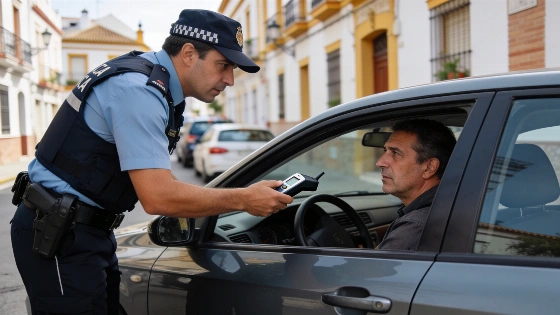
A driver in Castilleja de la Cuesta (Seville) could face prison time and a lengthy driving ban after police stopped him for a series of dangerous moves behind the wheel. Officers said he was driving without a seatbelt and using his phone. His erratic driving prompted them to stop him.
A breathalyzer test showed one milligram of alcohol per liter of exhaled air, four times the legal limit of 0.25 and well above the criminal threshold of 0.60. The man denied drinking and told officers vinegar in his gazpacho had caused the high reading.
In September 2026, Spain's government and Interior Ministry began actively promoting an initiative to lower the legal alcohol limit for drivers to 0.2 g/l blood or 0.1 mg/l breath, citing a rise in road fatalities over the summer.
Police rejected his explanation. He was formally informed of his rights as a suspect in a road safety offense, which can carry three to six months in prison. Penalties can also include a fine of up to a year or community service, along with a driving ban of one to four years. The case will go to a fast track trial, as is usual for these offenses in Spain.
Officers said his erratic movements led them to stop him. They also noted that he was not wearing a seatbelt and was using his phone. Clear signs of alcohol use prompted the breath test. His claim about gazpacho did not affect the legal process, as Spanish law does not accept food ingredients as a defense for exceeding alcohol limits.
The incident comes as Spanish authorities step up efforts against drink driving, especially after a summer with more road deaths. As reported earlier, the government is under pressure to tighten enforcement and lower legal alcohol limits for drivers after a series of fatal accidents.
Spanish media reports put the current legal alcohol limit for most drivers at 0.5 g/l blood or 0.25 mg/l breath. Novice and professional drivers face a stricter threshold of 0.3 g/l blood or 0.15 mg/l breath. Administrative fines for exceeding these limits typically range from 500 to 1,000 euros, with 4 to 6 penalty points. Exceeding 0.60 mg/l breath is prosecuted as a criminal offense that can carry imprisonment.
Spain has some of Europe's strictest alcohol limits for drivers, and enforcement has grown tougher in recent years. The law sets a maximum of 0.25 milligrams per liter of air for most drivers, with lower limits for professional and new drivers. Exceeding 0.60 is treated as a criminal offense rather than an administrative violation. Penalties are severe, reflecting the authorities' efforts to reduce road deaths and injuries linked to alcohol. Excuses based on food or medication, among other factors, rarely succeed in court. The case reflects Spain's current zero tolerance approach to traffic enforcement, where explanations such as this do not replace compliance with the law.