

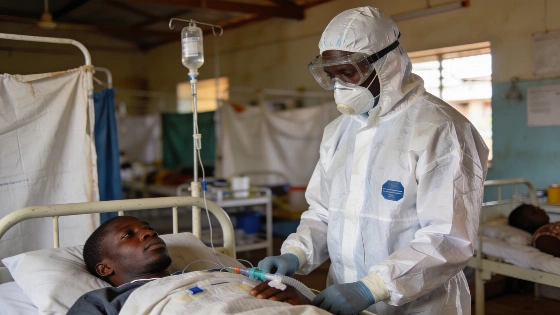
The Ebola epidemic in DR Congo has surpassed 2,400 deaths and 5,100 cases. Authorities struggle to contain the Bundibugyo variant amid resource shortages and late detection. WHO intensifies its intervention.
The Democratic Republic of Congo is facing its most lethal Ebola outbreak to date, with over 5,100 infections and 2,420 deaths recorded since the start of the year. The Bundibugyo variant, now affecting six eastern and northeastern provinces, has outpaced previous crises and exposed critical gaps in the country’s health response.
In Bunia, capital of Ituri province and one of the hardest-hit areas, fear has become part of daily life. Residents like Hubert Nendakala, who recently lost two family members working in border police, warn that underestimating the threat could have devastating consequences. The World Health Organization (WHO) has classified the risk as “very high” for DR Congo, “high” for neighboring countries such as Uganda, and “low” for the rest of Africa.
This outbreak, the seventeenth in DR Congo’s history, has already surpassed the 2018 epidemic in terms of fatalities. The rapid escalation has drawn comparisons to the West African crisis of 2014–2016, which claimed over 11,300 lives. According to Tom Fletcher, the UN’s humanitarian chief, a person is dying every 30 minutes in DR Congo from this strain, for which no approved vaccine or treatment currently exists. Existing vaccines target the Zaire strain and are ineffective against Bundibugyo.
WHO Director-General Tedros Adhanom Ghebreyesus acknowledged that the outbreak remains far from controlled. Many deaths are occurring outside health facilities, within communities, and among people not previously identified as contacts. More than 55 health zones are now affected, and over 1,000 patients have recovered after symptomatic treatment.
Containing the transmission chain remains a major challenge. Dr. Jean Kaseya of Africa CDC reports that 60–70% of deaths have occurred within communities rather than hospitals. In contrast, Uganda managed to halt its Bundibugyo outbreak in July after just a few dozen cases, thanks to early diagnosis and intensive contact tracing—a stark difference from the delayed response in DR Congo.
Hervé Amani, a local governance and human rights advocate, criticizes the slow and inadequate reaction from authorities. He argues that the focus should be on anticipating challenges and adapting the response, rather than relying on past experience. Delayed detection has been linked to initial misdiagnoses, as early symptoms resemble malaria, typhoid, or seasonal flu, and available tests were designed for the Zaire variant, missing Bundibugyo cases.
To address the crisis, WHO has announced increased community surveillance, expanded treatment capacity, and deeper engagement with local populations to build trust. Clinical trials for two experimental vaccines are underway, and efforts are being made to ensure safe and dignified burials to prevent further spread during traditional rituals. Thierno Baldé, WHO’s Bundibugyo response lead in DR Congo, says the strategy now centers on decentralizing operations and bringing support closer to affected communities. However, he cautions that a precise timeline for control is impossible, though the outbreak could be reversed within three months if resources are secured.
Funding remains a critical obstacle. WHO has received only 60% of the $115 million needed, as international aid has been sharply reduced, particularly following a 70% cut in US health sector funding for DR Congo. Despite this, plans are in place to increase treatment capacity to 3,000 beds and ensure proper training for medical staff.
While the Ebola crisis in DR Congo dominates headlines, other humanitarian emergencies in the region continue to draw attention. For example, the rapid expansion of a migrant camp on Ceuta’s El Trampolín beach has highlighted ongoing migration pressures and the challenges of managing public health and safety in border areas, as reported in coverage of the Ceuta settlement situation.
For context, Ebola is a viral hemorrhagic fever with a high fatality rate, transmitted through direct contact with bodily fluids of infected individuals. The Bundibugyo variant, first identified in Uganda in 2007, is less well-studied than the Zaire strain. The current outbreak’s scale and speed have underscored the importance of rapid detection, community engagement, and international support in managing such epidemics. The situation in DR Congo remains volatile, with the risk of further spread if containment measures falter or funding gaps persist.



