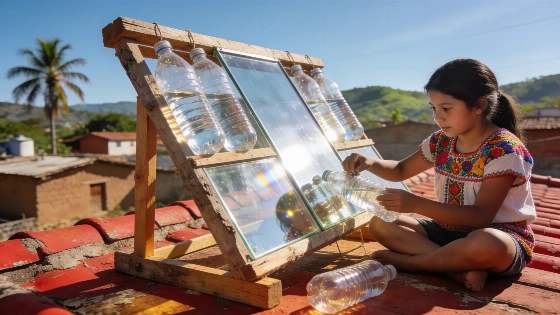
At just eight years old, Xóchitl Guadalupe Cruz López from Chiapas designed a solar water heater using discarded materials. Her homemade system helps families access hot water without relying on firewood, reducing both costs and environmental impact. The project has drawn national attention for its ingenuity and social value.
When Xóchitl Guadalupe Cruz López was only eight, she set out to solve a problem that affected her family and many others in her community: the lack of affordable hot water. Using discarded PET bottles, a length of hose, wooden planks, and glass doors salvaged from a broken refrigerator, the young girl from San Cristóbal de las Casas, Chiapas, built a solar water heater that would later be recognized for its ingenuity and impact.
The device, which Xóchitl named “Baño Calientito,” was designed to provide hot water without the need for expensive equipment or firewood. According to the National Autonomous University of Mexico (UNAM), the project stood out for its use of recycled materials and its reliance on solar energy—a renewable resource abundant in the region.
Turning Waste into Practical Solutions
With the help of her father, Xóchitl assembled the prototype using ten PET bottles, a hose, wooden supports, and glass panels. The system was installed on the rooftop, where sunlight could be captured most efficiently. The PET bottles, painted black, absorbed heat from the sun, while the glass helped retain the warmth, allowing the water inside the hose to reach temperatures as high as 44.5°C—significantly higher than uninsulated alternatives.
As reported by El País, the total cost of materials ranged from 180 to 200 Mexican pesos, making the invention accessible to families with limited resources. Over time, the heater’s capacity was increased to hold up to 50 liters of water, enough for basic household needs.
Reducing Reliance on Firewood
For many families in Chiapas, heating water means burning firewood—a practice that not only contributes to deforestation but also exposes people to harmful smoke. Xóchitl’s invention offered a practical alternative, especially for those unable to afford conventional water heaters. In an interview with La Jornada, she described witnessing families cut down trees to cook and heat water, a cycle that damages both the environment and public health.
The project’s recognition extended beyond its technical merits. In 2018, Xóchitl received the ICN Recognition for Women from the Institute of Nuclear Sciences at UNAM, highlighting the importance of early access to science and technology for children. Her participation in the PAUTA program, which encourages young talent in mathematics and science, further underscored the value of nurturing curiosity and problem-solving skills from a young age.
Simple Physics, Real Impact
The effectiveness of the “Baño Calientito” system lies in its simplicity. Black-painted bottles maximize heat absorption, while the glass enclosure minimizes heat loss. Water circulates through the hose, gradually warming up before use. This approach not only saves money but also reduces the need for firewood, offering a cleaner and more sustainable way to meet daily needs.
Innovative home solutions like Xóchitl’s echo a broader trend toward practical, low-cost ways to improve comfort and efficiency. For example, as explored in this guide to cooling rooms without air conditioning, simple adjustments and resourceful thinking can make a significant difference in everyday life.
Encouraging Grassroots Innovation
Xóchitl Guadalupe Cruz López’s story is a reminder that impactful solutions can come from unexpected places. Her solar water heater not only addresses a pressing need in her community but also demonstrates how accessible technology and creativity can drive change. As more families seek affordable and sustainable options, grassroots inventions like this may play a growing role in shaping the future of energy use and environmental stewardship.