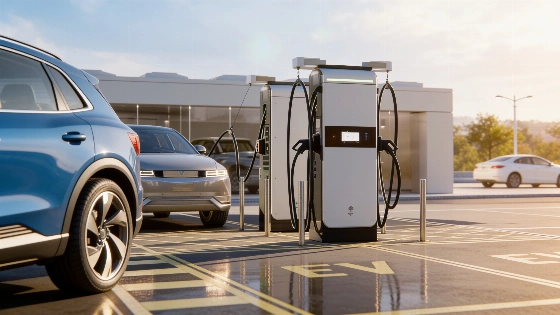
A new analysis reveals that charging times above 24 minutes are deterring Spanish drivers from embracing electric vehicles for long journeys. High costs and a lack of fast public chargers are compounding the problem.
For many Spanish drivers thinking about electric cars, one number keeps coming up: 24 minutes. The Arval Mobility Observatory 2026 found that this is the point where a charging stop becomes too long for most people making long trips. Nearly four in ten corporate drivers say if charging takes longer, it just doesn't fit into their workday.
But the reality on Spanish roads is different. Filling up a petrol tank takes only a few minutes, while most electric car owners prefer to charge overnight at home, when rates are lower. Only 28% use rapid chargers on highways, and even then, the cost can be high—ultrafast charging ranges from €6.46 to €11.34 per 100 kilometers, sometimes more than diesel or petrol. According to government data, as of September 2026, Spain has between 42,318 and 52,746 public charging points, depending on how they're counted. However, only a small share of these are the ultra-fast chargers needed to keep stops under 24 minutes.
The Spanish government launched the REVE platform in September 2026, providing real-time data on approximately 44,700 charging points and ensuring that 99% of Spain's territory is within 50 km of a public charger.
The real problem isn't just speed or price, but the network itself. An independent review using MITECO data found that Spain has about 3,964 public charging points with at least 150 kW—the minimum needed to reliably keep charging times below 24 minutes. For 30% of surveyed drivers, this shortage is the main reason they hesitate to use electric cars for longer trips. This number is lower than earlier estimates, showing the difference between total charging points and those that are actually high-powered.
Even when drivers find a fast charger, the data shows something interesting: the average stop lasts about 25 minutes, even though a charge of 18 to 23 minutes would be enough to keep going. Many drivers "overcharge," likely because they're worried about running out of battery or not finding another working charger. Industry sources like ANFAC also point out that up to a quarter of public charging points may be out of service at any time, making the network less reliable in practice.
Price transparency is another issue. Home charging is still the cheapest and easiest option, but unpredictable public charging fees—especially for ultrafast chargers—make some drivers think twice. High costs, limited infrastructure, and these psychological barriers are all holding back Spain's electric vehicle market. Government reports say there were about 950,000 electrified vehicles on Spanish roads in 2026, but the fast-charging network is not growing fast enough to meet the needs of long-distance drivers.
The Spanish government has mandated that, starting in 2027, all highway service stations with fuel sales above 10 million liters must install charging points with at least 600 kW capacity, aiming to address the shortage of ultra-fast chargers on intercity routes. However, connecting new high-power charging hubs to the grid can take up to three years, significantly slowing infrastructure expansion.
Official government sources
As reported by ElPlural.com, the way forward depends on three things: breaking the 24-minute barrier, expanding the network of 150 kW chargers, and making pricing clear and predictable. Without progress on all three, electric cars will remain a niche choice for Spanish drivers.
Recent news in the global electric vehicle market, such as the recall of millions of Teslas in China, shows how much infrastructure and user experience matter. In Spain, the numbers are clear: until charging is faster, cheaper, and easier to find, electric cars will struggle to move beyond early adopters. Without a real push on infrastructure and pricing, electric mobility in Spain is unlikely to become mainstream.