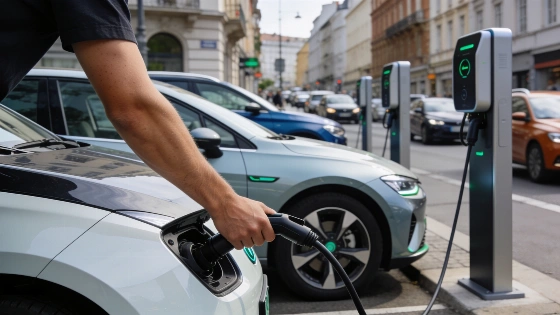
Global electric vehicle sales climbed 9% in July, led by a dramatic surge in Europe where government incentives have fueled demand. China and North America, however, show contrasting trends as the market landscape evolves.
Electric vehicle sales worldwide reached 1.85 million units in July, marking a 9% increase compared to the same month last year. This momentum, highlighted by data from Benchmark Mineral Intelligence, brings the total for the first seven months of 2026 to 11.5 million vehicles—up 4% year-on-year.
The driving force behind this growth is Europe, where a wave of government incentives has rapidly expanded the market. In July alone, 450,000 electric vehicles were sold across the continent, a 33% jump from the previous year. Europe now accounts for nearly a quarter of global EV sales, with France standing out: French EV sales soared 81% year-on-year in July, reaching a record 37% market penetration. Germany and the UK also posted robust gains, with sales up 46% and 43% respectively. Spain introduced the Plan Auto+ in July, offering retroactive incentives for electrified models from January 2026, which helped push Spanish EV sales up 34.5% in the first seven months, totaling 73,923 units and capturing a 9.8% market share.
China, the world’s largest car market, is facing a different reality. July saw a 5% year-on-year drop in EV sales, down to 980,000 units. Over the first seven months, Chinese EV sales declined 12% to 5.9 million vehicles. However, Chinese manufacturers are compensating with record exports—over 500,000 electric vehicles shipped abroad in July alone. This export push is partly aimed at improving profit margins and reducing the sector’s debt, which exceeds $400 billion. Many Chinese automakers are also establishing operations in Europe to bypass tariffs imposed by Brussels. The growing influence of Chinese battery and EV makers in Europe has been the subject of recent analysis, such as the expansion of CATL and BYD in the European market.
North America, meanwhile, is experiencing a slowdown. The expiration of US purchase incentives for electric vehicles in September 2025 led to a 27% drop in EV sales in July, with only 140,000 units sold. Cumulatively, North American sales fell 18% in the first seven months to 900,000 vehicles. Still, the US market showed signs of stabilization in the second quarter, with the year-to-date decline narrowing from -33% at the end of Q1 to -24% after Q2, and a 15% year-on-year drop in Q2 sales. Globally, the EV market closed the first half of 2026 with a modest 2% increase, totaling 9.6 million registrations.
According to elespanol motor, these shifts underscore the growing divergence between regions. While Europe’s aggressive incentives are reshaping the market, China’s export strategy and North America’s regulatory changes are creating new dynamics. The coming months will reveal whether Europe’s surge can be sustained and if other regions will adapt to the evolving landscape.
For context, electric vehicles now represent a significant share of new car sales in several European countries, and the sector’s rapid transformation is influencing global supply chains, battery production, and policy debates. The interplay between local incentives, international trade, and technological innovation will likely define the next phase of the EV revolution.