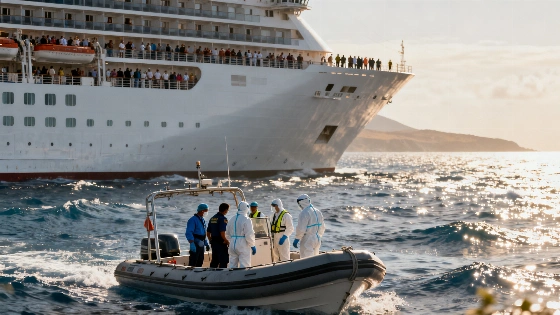
Cruise Ship MV Hondius Blocked Due to Hantavirus Outbreak: Spain and WHO Decide Next Steps. The MV Hondius cruise ship with 150 passengers has been blocked off Cape Verde after hantavirus was detected on board. Spain and the WHO are conducting an emergency inspection of the vessel to determine further actions and minimize risks for passengers and crew.
Key fact: The cruise liner MV Hondius, en route from Argentina to the Canary Islands, has been detained off the coast of Cape Verde after cases of hantavirus were detected on board. Spain and the WHO are conducting an emergency epidemiological inspection of the vessel to decide on its further route and safety measures.
News summary
There are about 150 people on board the MV Hondius, including citizens of the EU, USA, UK, the Netherlands, and one Russian crew member. After being denied entry to the port of Cape Verde, the vessel is awaiting a decision from international and Spanish authorities. Until the epidemiological inspection is complete, no decisions will be made regarding the route or repatriation of passengers.
Why it matters
The case of MV Hondius is a rare instance of hantavirus being detected on a cruise ship, highlighting the vulnerability of even modern liners to infectious threats. The incident may impact trust in the cruise industry, especially on popular routes between South America and the Canary Islands, and will serve as a test for international response protocols.
Context
The liner departed Ushuaia (Argentina) three weeks ago and was scheduled to finish its cruise in the Canary Islands — a key destination for European tourists. Hantaviruses are usually carried by rodents, but in the confined environment of a ship, the risk of human transmission increases. The outbreak comes as the cruise industry is recovering from the COVID-19 pandemic, making sanitary measures and passenger trust especially critical.
Who is affected
- Passengers and crew of the MV Hondius — directly, due to the risk of infection and uncertainty about the route.
- Tour operators and cruise companies — due to possible decreased demand and the need to revise safety protocols.
- Port authorities and health services of Atlantic countries — due to the need for prompt response.
- Potential tourists on similar routes — indirectly, through possible changes in rules and schedules.
What may change
- The MV Hondius itinerary may be adjusted or canceled depending on the results of the inspection.
- A temporary suspension or tightening of sanitary requirements for cruise ships on routes between South America and Europe is possible.
- Reputational and economic consequences for cruise operators and ports in the region.
What is still unknown
- The exact number of sick individuals and the extent of hantavirus spread on board.
- Whether passenger disembarkation will be allowed and at which location.
- What additional measures the WHO and the Spanish Ministry of Health will propose to prevent further spread of the infection.
- Whether there is a link between the outbreak and the sanitary condition of the ship or ports where it previously docked.
How to avoid misinterpretation
- It is not appropriate to compare the situation with mass COVID-19 outbreaks: hantaviruses are transmitted differently and are not as contagious between humans.
- There are currently no reports of serious complications or fatalities among MV Hondius passengers.
- The decision on the route and disembarkation will be made only after the epidemiological inspection is completed — it is too early to draw conclusions about the fate of the vessel.
Conclusion
The situation with MV Hondius is an important test for international sanitary protocols and trust in the cruise market. The main question is how quickly and efficiently the authorities can minimize risks for passengers and prevent the spread of infection. The results of the epidemiological inspection will determine further actions and may influence regulations for the entire industry.