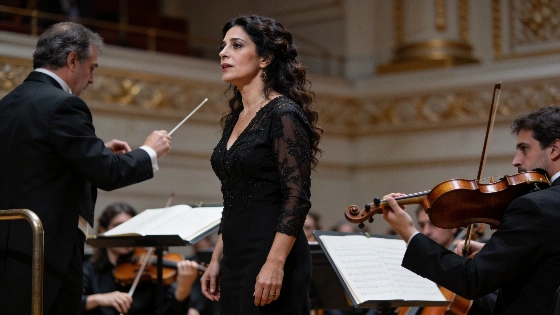
Estrella Morente will perform Manuel de Falla and Federico García Lorca with the Atlántida Chamber Orchestra. The project begins in Seville on 25 October 2026 and continues across Spain.
The first concert is set for the Cartuja Center in Seville on 25 October 2026. Estrella Morente will perform with the Atlántida Chamber Orchestra in a programme built around Manuel de Falla and Federico García Lorca.
The programme brings her flamenco voice to Falla's El amor brujo and revisits Lorca's Canciones españolas antiguas. Morente says she has found a healthier way to use her voice.
The challenge is direct. Falla's celebrated version of El amor brujo calls for a soprano, while Morente comes from flamenco. The invitation gives her a way into a classical language that rarely makes room for cantaoras. She is not leaving her technique behind. Instead, she is combining it with methods learned from the orchestra's musicians.
The project gives Falla’s music added historical weight by linking it to the 150th anniversary of the composer’s birth.
Manuel Tévar leads the Atlántida Chamber Orchestra. Founded in 2015, the ensemble has spent a decade working with contemporary music and revisiting Spain's musical past. It presents itself as a link between new repertoire and older Spanish works.
Tévar sees Morente as the right voice for Falla's score. He has explained that Falla treated flamenco as part of the music's structure, not as decoration.
Morente describes the project as powerful for both artistic and physical reasons. In earlier periods, she has said, she damaged her voice by using it without enough technical control. The orchestra has given her a demanding setting. Respect, curiosity and the willingness to ask questions now shape the performance.
The programme opens with Canciones españolas antiguas. Lorca collected and harmonised the popular songs in 1931. La Argentinita later made them famous through her singing and dancing.
Morente's connection to the music is personal. Her father, Enrique Morente, gave her the recording when she was 12.
Morente has confirmed that the programme will use Falla’s 1914 version of El amor brujo, with texts by María Lejárraga. She has described taking part in the project as both a gift and a privilege.
She has already recorded her own interpretation of the songs with Javier Perianes. Now she returns to Nana de Sevilla, Zorongo and Los cuatro muleros. Tévar has arranged them for the orchestra's 14 instruments.
Morente has said she is moved by the chance to revisit music linked to La Argentinita. She sees the performer's precision and determination as part of her artistic legacy.
The tour continues at Fórum Evolución in Burgos on 18 December. Madrid follows at the Auditorio Nacional on 8 January 2027. The next concert takes place at the Auditorio Manuel de Falla in Granada on 9 January.
Further dates are scheduled at the Centro Cultural Miguel Delibes in Valladolid on 28 February and the Auditorio de Zaragoza on 12 June. Docenotas describes the schedule as a full Spanish tour, not a one-off concert.
The programme also forms part of a wider tribute to women performers. Morente's next album will move into jazz and revisit Nina Simone, Chavela Vargas, Rocío Dúrcal, Edith Piaf and "la Jurado".
She presents the record as a thank-you to women who worked through difficult circumstances to build their careers. The family name has also appeared in earlier family coverage. This project puts Enrique Morente's artistic inheritance at its centre.
That inheritance is substantial. Enrique Morente expanded flamenco through poetry and experimentation. He also worked with writers such as Lorca, Miguel Hernández, Pedro García San Juan de la Cruz and Teresa de Jesús.
Estrella is taking the same instinct into another musical setting. Her move into classical repertoire does not reject flamenco. It shows how the tradition can develop without losing its voice.
This is more than a crossover.
The Atlántida collaboration gives that idea a concert stage, a defined programme and a tour with dates in six Spanish cities.