
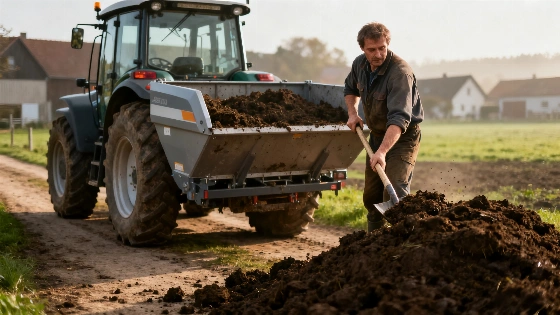
EU Bets on Cow Manure Instead of Gas for Fertilizer Production. The European Union is preparing to replace imported gas in fertilizer production with agricultural waste. The new plan from the European Commission has sparked debates among farmers and politicians, who express concerns over food security and rising prices.
The European Commission is preparing to publish a strategy that could change the traditional fertilizer production scheme in Europe. According to Politico, Brussels proposes to end reliance on imported gas and focus on using cow manure and other farm waste as raw materials for fertilizers.
Until now, most European fertilizers have been produced from natural gas, a significant portion of which was imported. However, after the cessation of shipping through the Strait of Hormuz and the resulting raw material shortage, the idea of switching to alternative sources—advocated by the European Commission since 2022—has suddenly become particularly relevant.
According to Politico, the new European Commission plan will be presented on Tuesday and aims at long-term measures. In particular, it proposes expanding the use of organic waste instead of relying on quick fixes such as lifting tariffs on fertilizer imports from Russia and Belarus or temporarily removing other trade barriers. Brussels considers such steps to be politically too sensitive.
The agricultural sector's reaction has been mixed. Herbert Dorfmann, Member of the European Parliament and a member of the Agriculture Committee, emphasized that manure can be part of the solution, but cannot fully replace urea- and nitrogen-based fertilizers. José María Castilla, a representative of the Spanish association of young farmers ASAJA, pointed out that European farmers cannot wait for the implementation of long-term strategies when costs are rising and domestic fertilizer production is decreasing. According to him, it's not just about prices, but also about Europe's strategic autonomy and food security.
The search for alternative raw materials for the agricultural sector is becoming increasingly urgent against the backdrop of global changes in the energy sector. Similar efforts to find new solutions are underway in other industries: for example, car manufacturers are looking for alternatives to lithium batteries, as demonstrated by Geely, which is betting on methanol—more on this can be found in the article about new approaches to energy in the automotive industry.
Experts note that switching to organic waste in fertilizer production could reduce dependence on external suppliers, but will require significant investment and time to restructure infrastructure. In the coming months, it will become clear how ready European farmers and policymakers are for such a shift and what compromises will be found between the economy, the environment, and food security.