Dozens of families in Sant Gervasi remain displaced after a sinkhole linked to Metro L9 construction. Authorities require at least three days to monitor ground stability. Most evacuees are staying with relatives or in hotels.
Nearly one hundred households in Barcelona’s Sant Gervasi - La Bonanova district have been forced to leave their homes after a sinkhole opened up during Metro L9 construction. The Generalitat, responsible for the works, has confirmed that residents from eight buildings will not be able to return until at least Saturday. This extended evacuation is necessary to allow technical teams to monitor the ground for a minimum of three consecutive days, ensuring no further soil movement threatens the area’s stability.
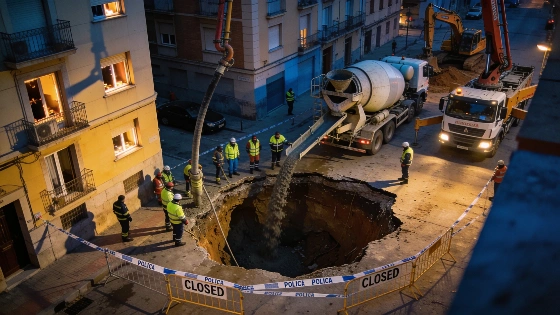
The incident began on Tuesday when a patio behind several residential blocks, including the well-known Verona pizzeria, collapsed. The sinkhole was triggered by detected ground shifts at a depth of 40 meters, where a massive tunnel boring machine is currently advancing the new metro line. The affected buildings—located at 2, 4, and 6 Rubinstein Street, 3 and 5 Teodora Lamadrid, and 54, 56, and 58 Sant Gervasi de Cassoles—comprise 93 apartments. Most residents spent the night with family or in hotels, while only one person used municipal facilities provided by social services.
Emergency crews responded by pouring concrete into the cavity for hours, a process that continued late into Tuesday evening. The area remains under close watch by firefighters, local police, and geologists. The Generalitat’s Department of Territory emphasized that continuous, hour-by-hour monitoring is underway, with dozens of sensors installed along the affected streets to detect any further shifts. The geological complexity of the site, where the subsoil transitions from granite to slate, adds to the challenge of securing the tunnel and surrounding structures.
This event has revived memories of previous incidents in Barcelona’s metro expansion history. In 2005, a much larger sinkhole during L5 construction in El Carmel led to the evacuation of over 1,000 people and the demolition of several buildings, sparking a prolonged political and social crisis. While the current sinkhole measures eight meters in diameter and four meters deep—significantly smaller than the El Carmel disaster—authorities are taking no chances. The L9 project uses a different tunneling method, with the machine simultaneously boring, installing a 12-meter metal arch, and lining the tunnel with concrete to enhance safety. For context, a similar evacuation in Barcelona’s Putxet district was reported when a large sinkhole forced dozens from their homes, as detailed in this earlier coverage.
The Sant Gervasi area has a history of ground instability, with a fatal collapse recorded in 1962 and a pavement upheaval near the Mercedarias convent as recently as May this year. The current evacuation underscores the ongoing risks associated with major underground infrastructure projects in Barcelona’s older neighborhoods. According to public records, the L9 line is one of the most ambitious metro expansions in Europe, designed to connect key districts and improve urban mobility. However, the project has faced repeated delays and technical challenges due to the city’s complex geology and dense urban fabric. The authorities’ cautious approach in Sant Gervasi reflects lessons learned from past incidents and the priority placed on resident safety during large-scale construction works.