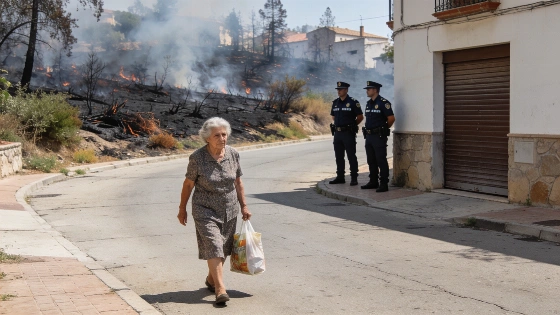
A wildfire near La Vilavella triggered urgent evacuations. One deaf woman, unable to hear alarms or alerts, remained unaware and alone. The incident exposes gaps in emergency communication for vulnerable residents.
When wildfire alarms sounded across La Vilavella last Saturday, the entire town was thrown into chaos. Sirens blared, church bells rang, and police knocked on doors, urging residents to evacuate as flames from the Vall d’Uixó fire approached the town’s edge. Yet, amid the rush, one resident—a deaf woman aged 81—remained completely unaware. She did not hear the bells, the pounding on her door, or the ES-Alert notifications that sent thousands fleeing. Her isolation highlighted a critical flaw in emergency systems that rely solely on sound.
The woman, who lives in the town center, was left behind as neighbors hurried to safety. According to her niece, who communicates with her in sign language, attempts to reach her failed because she was traveling at the time. Both women have chosen to remain anonymous. While the rest of La Vilavella’s 3,000 residents gathered in sports halls or found shelter with relatives, the woman stayed at home, watching television images of the fire but missing the audio warnings that would have told her the danger was at her doorstep.
Outside, the situation was tense. Residents like María Sales, 80, described the fear and confusion as smoke filled the streets and people rushed to evacuate. Some, like Rosario Borrás, left so quickly they abandoned essential items, including medicines. The fire reached the local school, and firefighters worked to contain the flames, but thick smoke made the air unbreathable and the town nearly deserted.
For two days, the deaf woman continued her routine, unaware of the evacuation. On Monday morning, she left her house for the market, only to encounter two surprised police officers who quickly contacted her family. She was then taken to a makeshift shelter in Nules, where she reunited with her niece and learned what had happened. The experience underscored the vulnerability of those who cannot access standard emergency alerts.
Her story is not isolated. As seen in other recent emergencies, such as the mass evacuations in Castellón, rapid communication is vital, but not all residents receive warnings equally. In La Vilavella, the return home was bittersweet. While some residents have resumed daily life, the landscape is scarred, and thousands remain displaced as authorities monitor the fire’s progress before allowing more returns. Officials have yet to announce when all evacuees can go back, reflecting ongoing uncertainty for affected communities.
Spain’s emergency alert systems have evolved in recent years, with mobile notifications and coordinated evacuations now standard in wildfire-prone regions. However, the La Vilavella incident exposes a gap for people with hearing impairments or other disabilities. Experts note that inclusive alert systems—using visual signals, vibration, and community networks—are essential to ensure no one is left behind during crises. As wildfires become more frequent and severe, adapting emergency protocols to reach all residents is increasingly urgent for local authorities and national agencies alike.