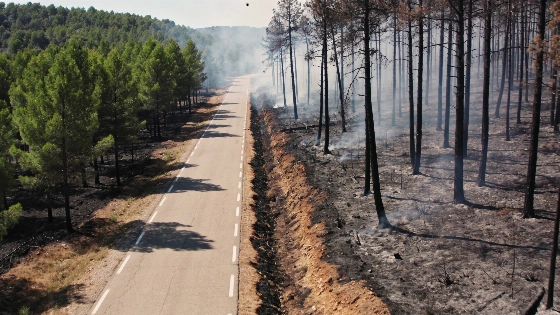
About 1,500 people were evacuated in the early phase of the wildfire emergency near Burgohondo in Ávila, including residents of a rural-tourism complex and a residential area in El Tiemblo. Emergency services set up temporary shelters, including at the sports center in El Barraco, where displaced residents waited for updates. Authorities also imposed confinement measures in Burgohondo and Navaluenga, as well as El Tiemblo, restricting movement to protect residents as the fire spread through the Alberche-Tiétar area.
Some residents wore masks to guard against smoke while gathering in designated shelters. The Military Emergency Unit (UME) deployed personnel and vehicles to support regional emergency services with firefighting and civil protection. The initial evacuation figure captured an early, geographically limited stage of the response. Later accounts described a much wider emergency across Ávila and Madrid, with evacuation estimates varying by period and by the areas counted.
Government officials monitored the response. Sara Aagesen, Vice President of the Government and Minister for the Ecological Transition and the Demographic Challenge, took part in coordination activity at the forest-fire information coordination center in Madrid. The Spanish Government declared an exceptional emergency situation covering the Community of Madrid and the province of Ávila. National and regional agencies coordinated firefighting and evacuations, as well as temporary accommodation.
Spain’s Civil Guard said the fire began on 22 July 2026, when sparks from heavy machinery ignited vegetation near Burgohondo. Strong winds contributed to its rapid spread. The fire threatened or affected communities across the area, including Burgohondo and Navaluenga, El Tiemblo and El Barraco, as well as Piedralaves and Casavieja. Subsequent reporting said the Civil Guard detained one person suspected of gross negligence and investigated a second person in connection with the blaze.
The fire’s eventual scale far exceeded the initial emergency: later assessments put the affected area at approximately 33,943 to 37,800 hectares, with some estimates approaching 38,000 hectares. Its perimeter reached around 160 kilometres. It was officially declared extinguished on 3 October 2026 and later described as one of Spain’s largest recorded wildfires. Those cumulative figures refer to the full fire, not the initial evacuation of about 1,500 people.
The consequences extended beyond burned vegetation. Later reports described damage to homes and businesses, alongside losses in agriculture, water infrastructure and forestry resources. Fundación Cesefor’s Micocyl program advised people to avoid affected mountain areas and not to consume mushrooms gathered on recently burned land, citing ash and combustion residues. The Junta de Castilla y León allocated €600,000 for restoration work on land affected by the Alberche-Tiétar fire.
Wildfires are a recurring challenge in Spain, particularly during periods of high temperatures and dry conditions. Rapidly spreading flames can threaten rural and urban communities, prompting evacuations, property damage and disruption to daily life. Spanish emergency protocols bring together agencies at local, regional and national levels, including the UME. Residents in affected areas are advised to follow official instructions and stay alert for updates from emergency services.