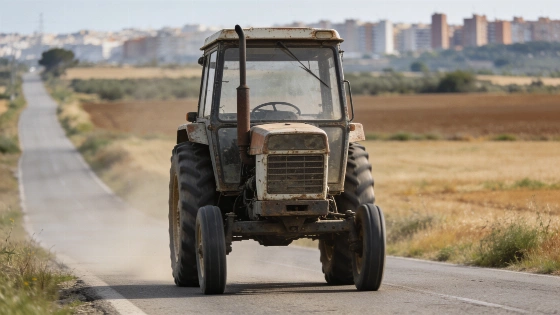
Farmers included a dedicated allocation for the Common Agricultural Policy in the European Union's 2028 to 2034 budget among their demands as five tractor columns set out for Madrid on 28 October. ASAJA and COAG called the mobilisation, with Unión de Uniones, under the slogan “Dar de comer tiene que dar para vivir. ¡Por un campo con futuro, soluciones YA!” over falling farm profitability and rising production costs. Organisers expected about 500 tractors, alongside thousands of farmers and livestock breeders. The union UPA did not take part.
The columns departed between 6:30 and 7:30. They set out from El Espinar in Segovia, Buitrago de Lozoya, Guadalajara, Torrejón de la Calzada and Arganda del Rey. The planned route was to converge at Colón at 11:00, then continue along Recoletos and the Paseo del Prado. It was due to finish near the Ministry of Agriculture at the Paseo de la Infanta Isabel. The demonstration was authorised to continue until 18:00. Asaja was weighing whether to cancel after a collision between two trains in Los Yébenes, Toledo, and was discussing the situation with other unions. The account did not establish whether the review led to a cancellation.
Arganda's column left about half an hour late. It comprised around 100 tractors and had a substantial police escort. Ivanna Martínez, COAG Madrid's secretary general, said the group expected to reach Colón in time.
El Mundo reported that agricultural diesel had become 51% more expensive, while fertiliser costs had risen 20%. The organisations cited those increases amid pressure on farm margins. They called for an emergency plan to ease production costs and a professional agricultural-diesel system. They also sought lower, stable taxation, with direct rebates when farmers refuel. The Agriculture Ministry had extended an agricultural-diesel rebate, but the unions considered the measure insufficient.
The organisers also sought fairer prices through balanced contracts. They called for mechanisms to revise terms when production costs rise. They want effective enforcement of Spain's Food Chain Law, which is intended to strengthen primary producers' position in negotiations with buyers. The organisations also called for farmers and cooperatives to have a stronger role. They demanded a sufficiently funded, dedicated CAP allocation in the EU's 2028 to 2034 budget. Their other complaints included paperwork and rules they said made farm work harder.
On trade, the groups opposed what they described as unfair competition in agreements involving Mercosur and Morocco. The mobilisation followed farmer demonstrations in January and February 2026 over potential CAP reductions and the EU-Mercosur agreement. The political dimension was also noted: the Ministerio de Agricultura, Pesca y Alimentación (MAPA) considered the planned mobilisation political. Separate coverage of Madrid PP candidates examined the party's congressional list.