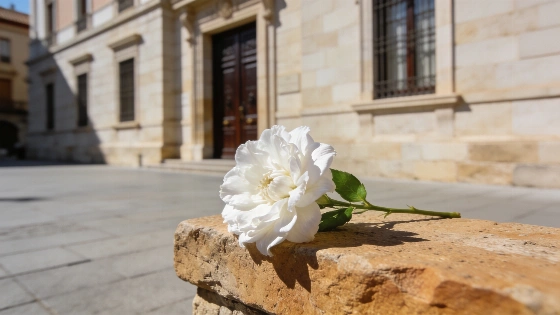
The 47 white flowers laid outside the Government Delegation in Toledo represent women killed by their partners or former partners in Spain so far in 2026. Four of the victims were in Castilla-La Mancha, or 8.5% of the national total. The Ministry of Equality’s provisional figures, updated on 23 November, recorded 1,388 women killed by a partner or ex-partner in Spain since the official series began in 2003.
The latest addition was a 37-year-old woman in Albacete, allegedly killed by her partner on 19 November. The Ministry of Equality confirmed the case on 23 November, bringing the 2026 totals to 47 nationally and four in Castilla-La Mancha. The previous update, on 20 November, had recorded 46 victims nationally and three in the region. The ministry’s provisional statistical sheet said no 2026 case remained under investigation as of 23 November.
The ceremony brought together Carlos Cuerpo, the Government’s first vice-president, and Milagros Tolón, the minister for education, vocational training and sport. Representatives of institutions and trade unions attended, along with members of the State Security Forces and Corps.
The regional government chose Iniesta in Cuenca for its main official 25N event, with a focus on digital violence. The source describes this violence as gaining ground alongside the growth of social media and artificial intelligence. The event drew attention to risks facing women and girls and the need for tools to address them. The national institutional 25N event, chaired by Minister for Equality Ana Redondo at Madrid’s Teatro Luchana, also recognised efforts to prevent gender-based violence among adolescents, including in digital environments.
Trade unions also held events. In Ciudad Real, Comisiones Obreras denounced what it called machismo-related denialism and racism. The union warned that a reactionary ideological offensive threatens advances in equality. Ana Villaseñor, the union’s secretary for Women and Equality in Castilla-La Mancha, called for scrutiny of how funds from the State Pact against Gender Violence are being used. She said prevention in society was lacking and blamed fascism and the far right. The union called for the pact and public policies protecting women’s lives and dignity to be strengthened.
At the University of Castilla-La Mancha’s Toledo campus, the Equality and Diversity Unit organised a joint reading of the Manifiesto por la eliminación de la violencia contra las mujeres at noon in the Sabatini building. The unit’s director, María Rodríguez Pérez, said progress had been made in women’s rights and freedoms, while stressing the need to show commitment to all victims.
In Albacete, pupils in the fifth and sixth years of primary school marched from one of their schools to Abelardo Sánchez Park. Children from three schools took part: Antonio Machado and Virgen de los Llanos, as well as Parque Sur. Their joint manifesto defended equality from an early age and rejected abuse. Now in its third year, the march forms part of an educational effort to help pupils recognise stereotypes and reject discrimination and abuse. The publication has also covered a separate regional story about the Sijena paintings transfer.
More demonstrations and gatherings are scheduled across the region this evening for the International Day for the Elimination of Violence against Women. Toledo’s march is due to start at 18:00 in Parque de la Vega and finish in plaza de Zocodover. In Guadalajara, a march is scheduled to begin at 19:00 at the junction with calle Toledo, then continue to the Bejanque roundabout.
Other announced gatherings include a 19:00 event organised by Coordinadora 8M at Albacete’s plaza del 25N, and a 19:00 Comando Violeta gathering on calle Carretería at the junction with Sánchez Vera in Cuenca. The Assembly of Feminist Women has called a 19:30 gathering in Ciudad Real’s plaza Mayor. Talavera de la Reina’s event is scheduled for 20:00 in plaza de San Francisco.