A rare alliance in Congress saw PP, Vox and Junts jointly call for Pedro Sánchez's resignation. Feijóo hints at a no-confidence motion, intensifying political pressure. The vote, though symbolic, marks a turning point.
Political tensions escalated in Madrid as the Partido Popular (PP), buoyed by support from Vox and Junts, secured a majority in Congress for a motion urging Prime Minister Pedro Sánchez to resign and submit to a confidence vote. The outcome, while not legally binding, has injected new volatility into Spain's political landscape, with opposition leader Alberto Núñez Feijóo openly considering a no-confidence motion against Sánchez.
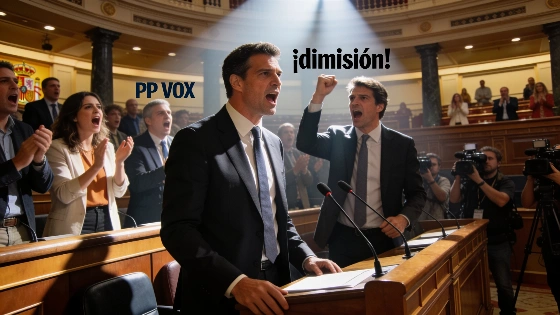
Immediately following the vote, PP deputies erupted in chants of “¡dimisión, dimisión!” within the chamber, underscoring the charged atmosphere. Feijóo, addressing journalists in the corridors of Congress, emphasized that any democratic leader should heed the will of the legislature. He accused Sánchez of disregarding the majority's demand and acting in defiance of parliamentary authority, framing the prime minister's stance as a challenge to democratic norms.
The motion, which united PP, Vox and Junts for the first time on such a critical issue, is seen by Feijóo as a historic moment for Spanish parliamentarism. He stressed that the executive's refusal to comply with the legislature's call for resignation would be carefully noted, suggesting that Sánchez's legitimacy is now questioned by a majority of deputies. Despite the symbolic nature of the vote, Feijóo left open the possibility of initiating a formal no-confidence motion, stating he would act “when the time is right, not before or after, and always in the interest of Spaniards.”
Asked whether Thursday's vote would prompt immediate action, Feijóo responded that he is taking the outcome seriously and will observe how the situation develops. He also hinted at the importance of maintaining unity among those who supported the motion, particularly referencing Junts, whose alignment with PP and Vox was unexpected. The opposition leader reiterated that his decisions would prioritize the country's interests over those of the current government.
This development comes amid a period of heightened scrutiny for Sánchez and his administration. Recent months have seen increased pressure on the PSOE leadership, as highlighted when a former party insider prepared to testify independently in court, a move that threatened to deepen internal divisions. For further context on the challenges facing Sánchez's government, see this report on growing legal and political pressures within PSOE.
While the current motion carries no legal force, its political weight is significant. In Spain, a successful no-confidence motion requires an absolute majority in Congress and the nomination of an alternative candidate for prime minister. Such motions are rare and have only succeeded once in recent history, when Sánchez himself replaced Mariano Rajoy in 2018. The latest vote signals deepening divisions and could shape the political agenda in the coming months, especially as alliances shift and the government faces ongoing scrutiny from both parliament and the public.