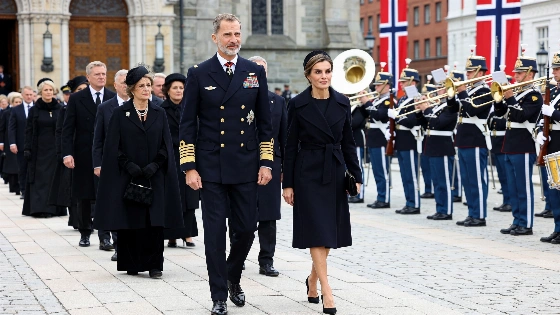
Felipe VI and Letizia walked in the funeral procession for Harald V in Oslo. The Spanish royals joined a rare assembly of European monarchs. The event drew global attention and highlighted Spain’s close royal ties with Norway.
King Felipe VI and Queen Letizia of Spain walked through the streets of Oslo in the funeral procession for Harald V of Norway, joining one of the largest gatherings of European royalty in recent memory. Queen Sofía accompanied them, reflecting the close personal and dynastic ties between the Spanish and Norwegian royal families.
The procession began at midday on September 9, 2026, starting at the Royal Palace and ending at Oslo Cathedral, as confirmed by Norwegian and Spanish media. Felipe VI wore his full naval dress uniform with the Collar of the Order of St. Olaf. Letizia walked beside him, and Queen Sofía was also present, marking Spain’s highest level of representation. The Spanish royals were placed among the closest foreign dignitaries to the Norwegian royal family, a detail noted by several Spanish outlets referencing official trip materials.
A nationwide minute of silence was observed across Norway just before the funeral procession began, marking the scale of national mourning.
Security was tight, with mounted police leading the cortege, followed by the Signal Corps of the Royal Guard, military bands, the Guard’s banner, an honor guard, and the Lord Chamberlain. The coffin traveled on an artillery caisson, flanked by aides-de-camp. The new king, Haakon VIII, and his immediate family walked in the procession. Queen Mette-Marit and Queen Sonia followed the route by car for health reasons, as outlined in the official order of the day from the Norwegian royal court.
Felipe VI’s relationship with the Norwegian royals goes beyond protocol. He is one of six godparents to Princess Ingrid Alexandra, the new heir, and has attended important moments in her life, including her confirmation and eighteenth birthday. This personal connection placed the Spanish delegation at the center of the official mourning, alongside King Carl XVI Gustaf and Queen Silvia of Sweden, King Frederik X and Queen Mary of Denmark, and other European monarchs. Reports in the Spanish and international press point to this godparent relationship as the reason for the Spanish royals’ special status at the ceremony.
The guest list included more than just royalty. Heads of state from Germany, Finland, Iceland, Poland, Hungary, Slovenia, Lithuania, Latvia, and Estonia attended, reflecting Harald V’s standing across Europe. The Japanese imperial family, Jordan’s King Abdullah II, and representatives from Liechtenstein and Monaco were also present. Among the confirmed guests were Prince William and Princess Anne from the United Kingdom, Crown Prince Akishino and Princess Kiko of Japan, and King Frederik X and Queen Mary of Denmark, showing the international scale of the gathering.
After the service at Oslo Cathedral, the funeral procession continued to Akershus Fortress, where King Harald V was interred in the royal mausoleum. This sequence was detailed in advance by Norwegian and Spanish sources, emphasizing the ceremonial and historical significance of the final resting place.
The funeral was led by Olav Fykse Tveit, head of the Lutheran Church, and the Bishop of Oslo, Sunniva Gylver, and lasted three hours. After the public ceremony, the coffin was taken to Akershus Fortress for a private family service, where Harald V’s remains were placed in the royal crypt. Meanwhile, the 450 official guests gathered at Oslo’s City Hall for a remembrance ceremony, before the new king and his family greeted the public from the palace balcony.
In their official message after Harald V’s death, the Spanish royal family described him as a model of responsibility, dignity, and dedication to Norway. Their statement, published on X, spoke of the loss felt not only by Norwegians but by royal houses across Europe. The Spanish presence in Oslo was more than protocol; it reflected the ongoing ties and mutual respect between monarchies that still play a role in Europe’s ceremonial and diplomatic life.
While the monarchy’s place in modern Europe is often debated, events like this funeral show the continued influence of royal networks. For Spain, Felipe VI and Letizia’s participation in Oslo signals the country’s commitment to its royal alliances and the quiet influence these relationships still hold in European affairs. Their visibility at such a high-profile event reinforces Spain’s standing among Europe’s monarchies and shows that tradition and personal bonds remain important at the highest levels of state.