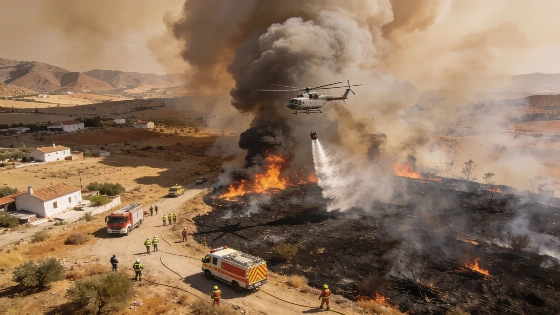
Authorities in Almería move from containment to direct attack on the Los Gallardos wildfire. The death toll stands at 12, with 8 injured and 23 still unaccounted for. Emergency services urge residents to follow instructions.
After a night marked by calmer winds and higher humidity, emergency teams in Los Gallardos, Almería, have begun a direct assault on the wildfire that has already devastated 6,600 hectares. The shift from defensive containment to active suppression was confirmed by Antonio Sanz, Andalusia’s regional minister for Presidency, Health and Emergencies, who described the improved weather as a critical turning point. For the first time since the fire broke out, the 500 personnel on site have a real opportunity to halt the flames’ advance.
The confirmed death toll remains at 12, with no new bodies found during recent searches by the Guardia Civil. Authorities continue to refer to 23 people as “unaccounted for” rather than officially missing, noting that some alerts came from individuals who had not been in contact with the persons concerned for years. Seven formal missing persons reports have been filed, but these do not correspond directly to the 12 confirmed fatalities. The number of evacuees stands at 1,448, with 164 temporarily housed in facilities set up by the Andalusian administration.
Biological samples from the deceased have been flown to Madrid for genetic analysis and identification. The Guardia Civil’s forensic teams are working to match DNA from the victims with samples provided by relatives who have traveled to the area. This process is expected to clarify the identities of those who lost their lives in the fire.
Both Félix Bolaños, Spain’s Minister of Presidency and Justice, and Antonio Sanz have repeatedly urged residents to strictly follow emergency instructions. Investigations suggest that failure to heed evacuation orders may have contributed to the deaths: nine people attempted to escape via a dead-end farm track, while another group of four tried to flee by car along a dry riverbed that became a deadly trap. The Guardia Civil has detained two individuals for defying evacuation orders and re-entering high-risk zones, resisting police efforts during the operation.
Firefighting efforts remain concentrated on the southwestern flank near Los Gallardos, where several active fire lines persist. Two helicopters and multiple aircraft are engaged in water drops, with 22 additional aerial units on standby. Officials stress that continued favorable weather—especially subdued winds—will be decisive in bringing the blaze under control. Some sections of the fire perimeter are nearly stabilized, but the northern area remains problematic.
The response to the fire has also sparked political friction. The Andalusian government’s decision not to use the ES-Alert emergency messaging system on Thursday night has drawn criticism from national officials. Antonio Sanz defended the move, citing technical reasons: the dispersed population and varying evacuation needs made targeted alerts impractical, and downed communication infrastructure would have limited effectiveness. Instead, local volunteers went door-to-door to warn residents. Félix Bolaños downplayed the dispute, emphasizing that such decisions are based on technical criteria.
Wildfires are a recurring threat in Spain, particularly in Andalusia, where dry conditions and strong winds can quickly escalate local blazes into major emergencies. The Los Gallardos incident highlights the challenges of coordinating large-scale evacuations in rural areas with scattered populations. In recent years, Spain has invested in advanced firefighting resources and emergency protocols, but the effectiveness of communication and evacuation strategies remains under scrutiny after each major incident. The outcome of the current response may influence future policy on emergency alerts and rural fire management across the country.