Patricia Serrano, 34, becomes Vélez-Málaga’s first female gravedigger. After a storm destroyed her nursery near Madrid, she found a new path in cemetery work. Her story highlights a rare career move in Spain.
Vélez-Málaga’s municipal cemetery has welcomed its first female gravedigger, marking a notable shift in a profession long dominated by men. Patricia Serrano, 34, started her new role this week after a turbulent year that saw her forced to leave Madrid when severe flooding destroyed her nursery business in Sevilla la Nueva. The move to Andalusia was unplanned, but Serrano quickly adapted, seeking work that would keep her outdoors and connected to plants—two priorities that shaped her job search.
Serrano’s journey began in late 2023, when a series of intense storms devastated her nursery and flower shop, leaving her with no choice but to relocate. She settled in Almogía, near Málaga, where her sister lived. With no clear plan, she relied on unemployment benefits while considering her next steps. Encouraged by her partner, who was preparing for firefighter exams, she explored public sector job openings in the region. Most available positions involved office work, which she wanted to avoid. Then, a public call for three cemetery worker positions in Vélez-Málaga caught her attention.
She began preparing for the competitive exams months in advance, studying topics ranging from legal regulations to cemetery operations and horticulture. Out of 25 candidates, Serrano was the only woman and achieved the highest scores in both written and practical tests. Her appointment as a permanent cemetery worker was confirmed on August 10, making her the first woman to hold this position in the town of 86,000 residents.
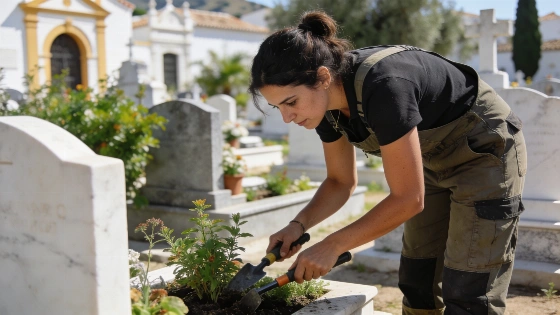
Serrano’s daily tasks include gardening, maintaining cemetery grounds, watering plants, and general upkeep. She has not yet participated in a burial, but she brings experience from her previous work with funeral homes, where she often assisted grieving families. She emphasizes the importance of empathy and respect in her new role, noting that cemeteries are places of silence and reflection rather than fear. Her integration into the team has been smooth, working alongside five colleagues, some of whom also secured their positions through the same competitive process.
The local council has publicly welcomed Serrano, and her arrival has attracted significant media attention after the municipality shared her story online. She prefers to keep interviews outside working hours and away from the cemetery grounds, out of respect for visitors. The presence of women in cemetery work remains rare in Spain, though there are precedents in other regions, such as Galicia and Granada, where women have broken similar barriers.
While Serrano’s case is unique, it reflects broader trends in Spain’s labor market, where women are increasingly entering roles once considered off-limits. The story also highlights the resilience required to rebuild a career after disaster. For context, the challenges faced by public service applicants and workers in Spain have been the subject of recent analysis, such as the growing delays in elderly care services in Madrid, as reported in a recent article on waiting lists for public care.
Spain’s cemeteries are typically managed by local councils, with staff responsible for both maintenance and assisting families during burials. The sector has seen gradual modernization, but traditional gender roles persist in many municipalities. Serrano’s appointment in Vélez-Málaga may encourage other towns to open similar opportunities. Her background in naturopathy and floristry, combined with her determination to work outdoors, made her a strong candidate for the role. As Spain continues to face labor shortages in certain public service areas, stories like Serrano’s illustrate the changing face of municipal employment and the importance of adaptability in the workforce.