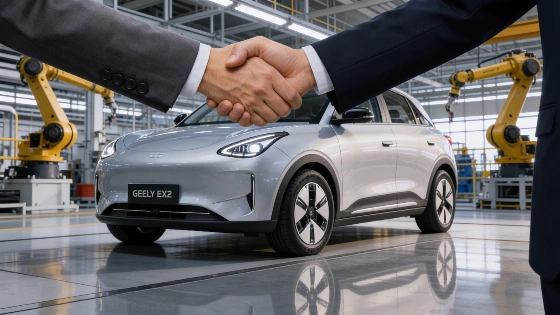
Ford’s Almussafes factory in Valencia will soon produce Geely’s best-selling electric SUV, following a joint venture that gives new life to the struggling plant. The move marks Geely’s first major manufacturing step in Europe and promises job stability for local workers.
Ford’s Almussafes plant in Valencia, long a cornerstone of Spain’s automotive industry, is set for a dramatic turnaround after years of uncertainty. The American carmaker has finalized a joint venture with China’s Geely Auto, paving the way for the production of Geely’s flagship electric SUV, the EX2, on Spanish soil. This agreement not only secures a future for the factory’s workforce but also signals a new era of collaboration between two global automotive giants.
Under the terms of the deal, Ford will retain a 66% stake in the new entity, while Geely Auto holds 34%. The partnership will transform the Almussafes facility into a high-tech, shared manufacturing hub, with both companies aiming to optimize resources and share development costs. According to official statements, the first Geely model is expected to roll off the production line in 2028, joining the Ford Kuga as the plant’s main output.
Securing Jobs After Years of Cuts
The Almussafes plant has faced a steep decline in recent years, losing four major Ford models—Mondeo, S-MAX, Galaxy, and Transit—from its production lines. With only the Kuga remaining, the factory struggled to maintain employment, resulting in four rounds of layoffs between 2020 and 2024 and leaving a workforce of just 4,300. The new joint venture offers a much-needed lifeline, promising long-term stability and the prospect of new jobs as production ramps up.
Ford’s original plan was to hold out until 2028, when a new multi-energy model, the Ford Bronco, was scheduled to begin production. However, with vehicle output having dropped by 71% over six years, the arrival of Geely’s investment brings immediate relief and a more optimistic outlook for the plant’s future.
Geely’s Strategic Move into Europe
Geely’s decision to manufacture in Valencia is driven by more than just expansion. By producing vehicles within the European Union, the Chinese automaker can sidestep tariffs that have complicated the import of Chinese-made cars. The EX2, which has dominated sales charts in China and is priced between €8,000 and €12,000, will now be built for the European market in Spain. The model is a compact electric SUV with two powertrain options: a 58 kW version delivering 78 hp and a 30.12 kWh battery, and a more powerful 85 kW variant with 116 hp and a 40.16 kWh battery, offering up to 480 kilometers of range on a single charge.
This move is part of a broader trend of Chinese automakers seeking to establish a manufacturing presence in Europe, both to avoid trade barriers and to replicate their domestic success abroad. The partnership with Ford gives Geely a strong foothold in the region and accelerates its ambitions to become a major player in the European EV market.
Industry Impact and Broader Context
The Ford-Geely alliance is one of the most significant industrial deals in Spain’s recent automotive history. It not only revitalizes a key manufacturing site but also reflects the shifting dynamics of the global car industry, where traditional and emerging players are increasingly joining forces to meet new technological and economic challenges. The deal echoes a wider pattern of innovation and adaptation, as seen with other manufacturers like Santana Motors, which recently relaunched its iconic Cajal 4x4 in Linares with a modern, tech-forward approach (see how Spanish brands are reinventing themselves).
For Valencia and Spain as a whole, the agreement is a clear signal of the country’s ongoing relevance in the European automotive landscape. As the industry pivots toward electrification and new business models, the Almussafes plant’s transformation could serve as a blueprint for other sites facing similar challenges. The coming years will reveal how this partnership shapes the future of car manufacturing in Spain and beyond.