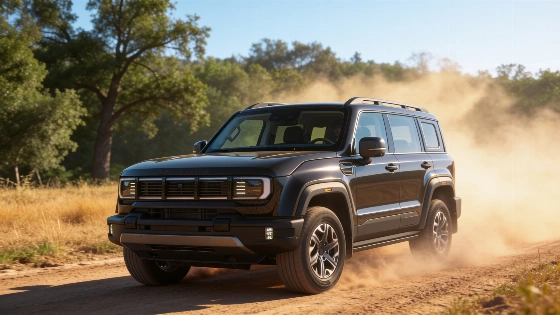
Santana Motors returns to the Spanish automotive scene with the Cajal, a rugged 4x4 built in Linares. Combining classic off-road engineering with a digital cockpit featuring five screens, the Cajal aims to redefine the segment for a new era.
Production lines in Linares, Jaén, are humming again as Santana Motors launches the Cajal, a new 4x4 that marks the brand’s return to its roots in off-road vehicles. Built on the BAIC BJ40 platform but tailored for European tastes, the Cajal is assembled alongside the Santana 400 and a compact electric model from JAC Motors, signaling a new chapter for a factory once synonymous with Land Rover and Suzuki.
Classic Form, Modern Ambition
The Cajal stands out with its squared, muscular silhouette—a deliberate nod to the golden age of off-roaders. Its imposing grille, distinctive LED lighting, and pronounced wheel arches evoke icons like the Land Rover Defender and Suzuki Jimny. Practical details abound: frameless doors, a split rear tailgate, and a rear window that opens independently for easy cargo access. The spare wheel, mounted on the lower tailgate, reinforces its off-road credentials. Measuring 4.79 meters long with a 2.76-meter wheelbase, the Cajal is designed to look—and act—the part in rugged terrain.
Digital Cockpit Revolution
Inside, Santana has broken with tradition. The Cajal’s cabin is a showcase of digital innovation, featuring five integrated screens that transform the driving experience. The driver faces a 10.25-inch LCD instrument cluster, while the center console hosts a 12.8-inch touchscreen for multimedia and vehicle controls. Unusually, a second 12.8-inch display sits in front of the passenger, offering entertainment options and real-time off-road data—such as vehicle tilt, wading depth, and differential status—so the co-driver can actively assist during challenging maneuvers.
Two more screens complete the setup: a 1.92-inch configurable display doubles as the start button, and a digital rearview mirror integrates a camera feed to maintain visibility even when cargo or terrain obscure the view. The tech package is rounded out by a 10-speaker sound system with subwoofer, wireless smartphone charging up to 50W, and ten power outlets distributed throughout the cabin. Leather seats, a panoramic roof, and flexible cargo space add comfort to the mix.
Engineered for Real Off-Roading
Under the hood, the Cajal stays true to classic 4x4 engineering. It forgoes electrification in favor of a 2.0-liter four-cylinder turbodiesel engine, delivering 163 hp and 390 Nm of torque. Power is managed by an eight-speed ZF automatic transmission and a selectable all-wheel-drive system with low-range gearing. The ladder-frame chassis, homologated tow hitch, and 2,500 kg towing capacity reinforce its utilitarian focus.
Drivers can choose between 2H, 4A, 4H, and 4L modes, supported by eleven terrain-specific programs for snow, sand, mud, rocks, water crossings, and tarmac. Off-road geometry is impressive: 22 cm ground clearance, 37-degree approach angle, 31-degree departure angle, and up to 80 cm wading depth. The Cajal is among the few vehicles in its class to offer three locking differentials—center, front, and rear—giving it an edge in extreme conditions. A tank-turn function, which locks the inner rear wheel, helps the vehicle pivot in tight spaces.
Reviving a Spanish Legacy
The Cajal is more than a new model; it’s a strategic move to reestablish Santana Motors as a force in Spanish manufacturing. The partnership with BAIC has enabled the brand to restart production in Linares, creating jobs and reviving a storied industrial site. As CEO Edu Blanco noted during the Madrid launch, these alliances are key to delivering “authentic and capable vehicles” while supporting the local economy.
Santana’s approach stands in contrast to the wave of urban SUVs dominating the market. By focusing on genuine off-road ability and advanced technology, the Cajal aims to carve out a niche for drivers who demand both adventure and comfort. This strategy echoes broader trends in the automotive world, where brands like Skoda have also pushed boundaries—such as when the Elroq RS outpaced classic supercars in a recent acceleration showdown, as reported here.
Context and Outlook
The relaunch of Santana Motors comes at a time when Spain is seeking to strengthen its industrial base and diversify its automotive sector. The Cajal’s blend of traditional engineering and digital sophistication positions it as a unique offering in a shrinking field of true off-roaders. While the market for such vehicles is niche, the Cajal’s arrival may signal renewed interest in Spanish-made cars that combine heritage with innovation.