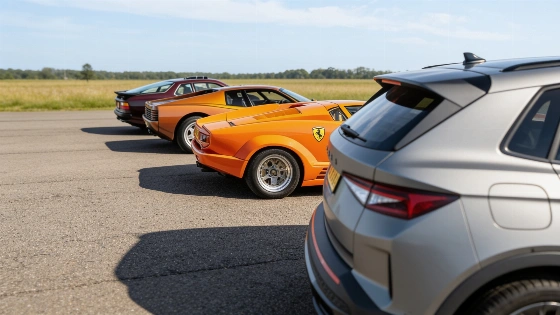
The Skoda Elroq RS, a modern electric SUV, has beaten legendary sports cars like the Lamborghini Countach, Ferrari Testarossa and Porsche 944 Turbo in a head-to-head drag race. The result highlights just how far EV technology has come in terms of raw acceleration.
At the Dunsfold circuit, best known as the filming location for Top Gear, the Skoda Elroq RS lined up against three of the most celebrated sports cars of the late 20th century: the Lamborghini Countach, Ferrari Testarossa and Porsche 944 Turbo. The goal was simple—see how a state-of-the-art electric SUV fares against icons of the combustion era in a quarter-mile sprint.
The Lamborghini Countach LP400, introduced in 1974, set the standard for supercars with its 3.9-litre V12 engine producing 379 hp and 368 Nm of torque. Paired with a five-speed manual gearbox, it could accelerate from 0 to 100 km/h in 5.4 seconds and reach a top speed of 309 km/h. The Ferrari Testarossa, launched a decade later, boasted a 4.9-litre flat-12 engine with 390 hp and 490 Nm, managing 0 to 100 km/h in 5.8 seconds and a maximum speed of 290 km/h. Completing the trio, the Porsche 944 Turbo arrived in 1985 with a 2.5-litre turbocharged four-cylinder engine delivering 250 hp and 350 Nm, sprinting to 100 km/h in 5.9 seconds and topping out at 260 km/h.
In contrast, the Skoda Elroq RS represents a different era entirely. Built on Volkswagen Group’s MEB platform, this electric SUV features dual motors for a combined 340 hp and a substantial 545 Nm of torque. Its 82 kWh lithium-ion battery (77 kWh usable) provides a range of over 550 km on a single charge and supports rapid DC charging up to 165 kW, allowing a 10% to 80% recharge in just 29 minutes. Despite weighing 2.2 tonnes and having a lower top speed of 180 km/h, the Elroq RS matches the Countach’s 0 to 100 km/h time of 5.4 seconds, thanks to instant torque and all-wheel drive.
When the lights went green, the advantage of electric propulsion was clear. The Elroq RS surged ahead from the start, its immediate power delivery making up for its weight disadvantage. The Ferrari Testarossa put up the strongest fight among the classics, finishing just fractions of a second behind the Skoda. The Lamborghini Countach and Porsche 944 Turbo, despite their pedigree, were unable to keep pace over the 402-metre distance.
This result underscores a broader shift in automotive performance. Electric vehicles, once seen as practical but uninspiring, now routinely challenge or surpass the acceleration of legendary combustion-powered sports cars. The Elroq RS’s victory is not just about numbers—it reflects how technology has redefined what’s possible for family-friendly vehicles. For context, the recent unveiling of the Zenvo Aurora Tur, a hybrid V12 hypercar capable of 0–400 km/h in 17 seconds, shows that the performance frontier continues to move rapidly in both electric and hybrid directions. More details on this trend can be found in the coverage of Zenvo’s record-breaking debut at Goodwood.
While the Elroq RS may not match the top speeds or the visceral drama of its classic rivals, its acceleration and usability mark a turning point. For many drivers, the gap between everyday practicality and supercar performance has never been narrower. As electric technology matures, such comparisons are likely to become even more common—and more surprising.