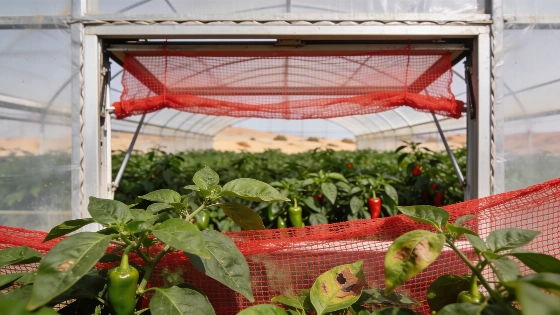
Severe damage affected 87% of the pepper crop under red mesh in an Almería trial, compared with 96% under standard white mesh. Results from 'Las Palmerillas' show the barrier delayed the arrival of adult Thrips parvispinus, but did not prevent serious damage.
The trial’s first count, taken 67 days after transplanting on 13 October, recorded an average of 5.9 adult thrips per plant under red mesh and 9.9 under the white-mesh control. Low-pressure misting recorded an average of 10.7. By 19 October, the averages had risen to 19 adults per plant under red mesh, 29 in the control and 18 with misting. The red-mesh count on 13 October was about 40% lower than the white-mesh count. These preliminary findings come from one trial.
Plataforma Tierra published three updates on the experiment at the Fundación Grupo Cajamar station. The trial used three 630-square-metre greenhouses in El Ejido, planted with California pepper variety Saitama on 7 August 2026. The same biological control was used in each greenhouse, but releases began in September and continued into October. The trial team says the beneficial insects were introduced late.
Barriers alone did not keep the pest below damaging levels. At the population peak, there were between 1.8 and 2.8 adult thrips for each predatory mite. Orius and Franklinothrips were scarcely recorded. Lacewings were scarcely recorded, too. The team is still investigating possible explanations for their limited presence, including interference from ants and possible competition for pollen between Orius and the pest.
Meanwhile, the Junta de Andalucía says it has carried out more than 900 inspections, leading to nearly 300 sanctioning cases over poor practices and inadequate crop clearance that helped the insect spread to neighbouring greenhouses. The regional government says inspections will continue and expand. A separate RUSSPAIN report on the Tarragona explosives unit covered an unrelated enforcement issue.
A technical panel of more than 40 plant-health specialists is considering a summer biological fallow period and mandatory biological control in spring and summer. Neither proposal has been adopted. The Junta’s visit to an affected greenhouse in El Ejido in mid-October also drew attention to the 2026/27 pepper campaign and the need for early detection and coordinated preventive measures.
The pest’s seasonal pattern helps explain the timing: populations rise in September, peak in October and November, remain high until January, then fall in March and April, according to the technical annex to Andalusia’s rules. The insect was detected in Almería peppers in 2020 and has ranked among the crop’s main pests since the 2022/23 season. Estimates of its spread vary by campaign and by whether they count greenhouses, farms or hectares.
Andalusia’s resolution of 10 April 2026, published in the regional official gazette on 17 April, sets required measures for affected protected crops. Before removing plants, growers must treat them and use mass trapping with blue and yellow sticky plates. They must notify neighbouring growers. Plant waste must be transported in closed conditions. Growers must apply diatomaceous earth to affected areas before the next transplant. Breaches are classed as serious offences under Spain’s Plant Health Law.
The trial also tested misting alongside different greenhouse coverings. Further work is planned on predatory mites, with refuge plants for beneficial insects also under study. October weather readings were almost identical across the three greenhouses, while August conditions differed. Results so far support early pest monitoring and timely releases of beneficial insects; they do not establish that one barrier will control the pest in commercial conditions.