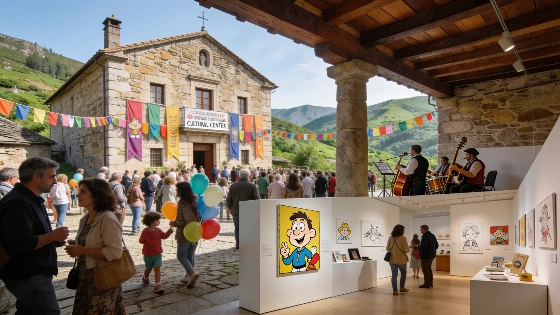
A Fonsagrada has inaugurated the Centro Cultural Forges, the first museum in Spain dedicated to Antonio Fraguas de Pablo. The initiative highlights Forges' deep ties to the region and his support for local and global causes. The centre occupies the former town hall, restored with local materials.
The municipality of A Fonsagrada in Lugo has officially opened the Centro Cultural Forges, Spain's first museum dedicated to the renowned cartoonist Antonio Fraguas de Pablo, known as Forges. The new centre, located in the historic heart of the village, stands as a tribute to the artist's enduring connection to his father's homeland and his commitment to social issues both in Spain and abroad.
The museum occupies the old town hall, a building dating back to 1845 that had been unused since 2015. Its restoration was carried out by local architects using regional materials, including chestnut wood from nearby sawmills. The project was funded by the local council, the Lugo provincial government, and the Ministry of Housing, reflecting a coordinated effort to preserve both cultural memory and architectural heritage.
Forges, whose father emigrated from A Fonsagrada to Madrid, maintained strong ties with the village throughout his life. He frequently contributed his art to local events, designing posters for festivals and gastronomy fairs free of charge. Many residents still keep his original drawings, and some restaurants display his sketches on paper tablecloths. His cousin Selelo, who passed away recently, was a key link between Forges and the community.
Beyond his artistic generosity, Forges used his platform to highlight the challenges facing rural Galicia. In the 1990s, he created a series of cartoons titled 'A Fonsagrada, eterna olvidada', drawing attention to the neglect of shrinking mountain communities. He advocated for essential services such as an elderly care home, an industrial park, and improved water supply—issues that remain partly unresolved decades later.
The museum's collection, assembled with the support of Forges' family, features replicas of his iconic cartoons from his early days at 'Pueblo' and 'La Codorniz' to his long tenure at 'EL PAÍS'. Visitors can explore the 'Diccionario Forgiano', a compilation of his invented words, as well as personal items like his work desk, glasses, and a miniature French-Spanish dictionary. Notably, the original archive of around 80,000 drawings is preserved at the National Library, while other materials are shared between the A Fonsagrada council and the University of Alcalá de Henares, which awarded Forges an honorary doctorate.
Forges' engagement with social causes extended beyond Spain. For years, he included references to Haiti in his daily cartoons following the 2010 earthquake. His support for A Fonsagrada was also visible during a 1991 protest against a regional law that threatened the village's status as a county capital. His message of solidarity became a symbol for the local movement, which ultimately succeeded in overturning the legislation.
The opening ceremony of the Centro Cultural Forges is set to be attended by the artist's family and the Minister of Foreign Affairs, José Manuel Albares. The event marks a significant moment for the village, which continues to celebrate its emigrant roots. In 2008, Forges illustrated the poster for the Festa do Emigrante, depicting villagers flying with suitcases from the Ancares peaks—a nod to the enduring bond between those who left and the home they never truly abandoned.
Contextually, the creation of the Centro Cultural Forges reflects a broader trend in Spain of revitalizing rural areas through cultural investment. Museums and cultural centres in small towns often serve as focal points for community identity and tourism, helping to counteract depopulation and economic decline. The recognition of Forges in A Fonsagrada not only preserves his artistic legacy but also underscores the importance of local heritage in shaping contemporary Spanish society.