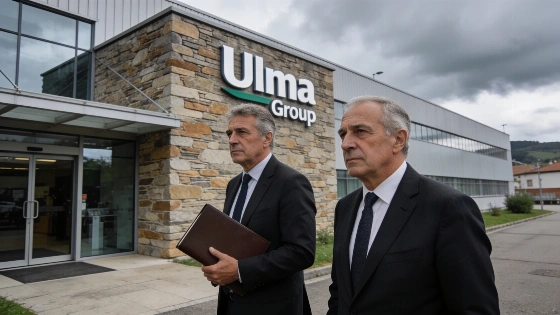
Iñaki Gabilondo, who led Ulma Group for 16 years, has died unexpectedly at 62. His passing leaves a mark on Gipuzkoa's business and cooperative landscape. The funeral will be held on Tuesday.
The sudden death of Iñaki Gabilondo Mugarza, former CEO of Ulma Group, has sent shockwaves through the business and cooperative community of Gipuzkoa. Gabilondo, who retired just months ago after 16 years at the helm, passed away unexpectedly at the age of 62, as confirmed by sources within the Oñati-based cooperative. His leadership was instrumental in shaping Ulma into one of the region's most prominent industrial groups.
Gabilondo took over as general director in 2009, succeeding Txomin García, and guided the group through a period of significant transformation. Under his direction, Ulma expanded to encompass nine cooperatives, employing over 6,000 people worldwide, with nearly half of them based in Gipuzkoa. The group specializes in industrial and logistics services, and its facilities are a familiar part of the Alto Deba landscape.
Born in Legazpi in 1964, Gabilondo dedicated most of his professional life to Ulma, holding various roles including management of Ulma Forged Solutions before assuming the top position. He held a degree in Business Administration from EHU and an MBA from Deusto. His approach was marked by a low public profile and a focus on management, steering clear of the spotlight even as he oversaw major changes, such as Ulma's exit from the Mondragon Group in 2022—a move that mirrored Orona's decision and marked a turning point for the cooperative sector in the Basque Country.
Gabilondo's final months at Ulma were spent ensuring a smooth transition to his successor, Aitor Ayastuy, who had previously led Ulma Construction. The handover was completed in April, with Gabilondo officially retiring in July. He remained involved in company matters until his last days, finalizing administrative tasks. He is survived by his wife and two children.
During his tenure, Ulma achieved record financial results. In 2025, the group reported its highest-ever consolidated revenue of €1.238 billion, a 7.6% increase, and a net profit of €94.8 million. These figures were reached despite a challenging global environment marked by economic uncertainty and geopolitical tensions. The company also secured €115 million in liquidity through a mix of loans, institutional agreements, and bond issuance, reinforcing its financial stability during the leadership transition.
Gabilondo attributed Ulma's resilience and growth to its strategy of geographic and sectoral diversification, with sales in over 80 countries and a broad range of business lines. In a rare interview in July 2024, he emphasized that this approach allowed the group to adapt quickly to changing market conditions.
Ulma's activities span agriculture, architecture, bulk transport components, engineering solutions for construction and industry, electronics lifecycle consulting, forged components, integrated logistics, packaging, and material handling. The group's deep involvement in the social and economic fabric of Alto Deba and Gipuzkoa has made it a key regional employer and a symbol of cooperative success.
The impact of Gabilondo's passing is reminiscent of other recent losses in Spain's business and public life, such as the death of Luis Ángel Echevarría, father of actress Paula Echevarría, whose funeral in Candás also drew significant attention from the community. For more on how such events affect local communities, see this report on the recent farewell to a prominent family figure in Gijón.
Gabilondo's funeral will take place on Tuesday, with colleagues and business leaders expected to pay tribute to a figure who helped define the cooperative model in Gipuzkoa. His legacy is likely to influence the region's economic landscape for years to come.
For context, the Basque cooperative movement is one of the most advanced in Europe, with Ulma and similar groups playing a central role in local employment and innovation. The sector's resilience has often been cited as a model for sustainable business in Spain, especially during periods of economic turbulence. Gabilondo's leadership style—focused on continuity, diversification, and community engagement—reflects the values that have underpinned the region's economic success. His passing comes at a time when many Spanish companies are navigating global challenges, making the stability and adaptability of cooperatives like Ulma particularly relevant.