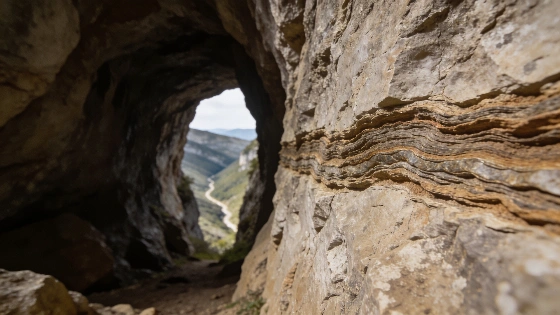
The 11 teeth came from two sites in central Spain, giving researchers a way to compare conditions before and during the Vallesian Crisis. The 141 enamel samples show stronger oxygen-isotope fluctuations at Batallones-10 near Madrid, dated to about 9.1 million years ago, than at Los Valles de Fuentidueña in Segovia, dated to about 9.6 million years ago. The sites are separated by roughly 500,000 years, and the Batallones-10 measurements display more pronounced repeated peaks and troughs than the flatter Fuentidueña pattern.
Those larger swings suggest seasonal differences had intensified by the time of the Batallones-10 deposits. The oxygen in the enamel reflects water consumed by the animals and can vary with environmental conditions, including temperature and rainfall. The pattern points to greater seasonal contrasts in temperature or water conditions; it does not establish which changed most. Dánae Sanz Pérez, a researcher at the Complutense University of Madrid during the study, described the pattern as an intensification of seasonality in reporting by National Geographic Historia.
The comparison spans the period of the Vallesian Crisis, an ecological transformation in Europe between 10 and 9 million years ago. A broader account places the crisis between about 11.6 and 8.7 million years ago. Mammals associated with wooded environments disappeared as communities shifted towards fauna adapted to more open and dry conditions. The changes included the disappearance of Miocene apes such as Hispanopithecus and Dryopithecus. Earlier studies had linked the crisis with increased aridity and seasonality; the tooth analysis adds evidence about variation through the year.
The method relies on enamel forming progressively. Researchers used serial sampling, taking very small samples at successive points along each tooth crown to create a sequence recording chemical changes during enamel development. Oxygen isotopes help track water conditions, while carbon isotopes provide information about the vegetation consumed. This sequence preserves changes within a tooth rather than reducing the record to a single average value.
Carbon readings varied little between the two sites. That suggests the équids’ overall diet remained relatively stable even as seasonal contrasts became more pronounced. The carbon signal provides a broad indication of the vegetation in the animals’ diet, while the oxygen record shows stronger variation in water-related conditions.
The study concerns climate patterns millions of years ago, a different subject from present-day planning; a Canary Islands university project also includes climate planning.