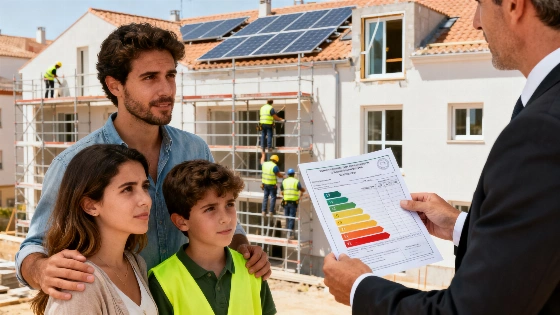
Spain Introduces New Housing Standards: Less Energy, More Control. Starting in 2026, new energy efficiency requirements for housing will take effect in Spain. The changes will affect both new buildings and the existing housing stock. Authorities aim to reduce energy consumption and accelerate the transition to environmentally friendly standards.
In the coming years, the Spanish housing market will face significant changes: starting in 2026, the updated Technical Building Code will come into force, aligning national standards with European energy efficiency requirements. This decision affects not only new developments, but also the existing housing stock and public buildings. The main goal is the gradual reduction of energy consumption and a transition to a fully decarbonized real estate sector by mid-century.
The reform is not limited to tightening energy consumption standards. It changes the very approach to designing, constructing, and renovating buildings, as well as the selection and handling of materials at every stage. The new regulations require developers, contractors, manufacturers, and authorities to take environmental criteria into account from the very beginning of a project. For future homeowners and those planning renovations, this means housing must not only be economical but also maximize the integration of renewable energy sources and comply with sustainable development principles.
Key stages of the reform
The document clearly defines deadlines and target indicators. Starting in 2026, all new projects must comply with the updated standards. By 2028, government buildings are required to become completely carbon-free, and from 2030, similar requirements will apply to all new construction. For the existing housing stock, a phased reduction in energy consumption is planned: by 2030 — by 16%, and by 2035 — by 20–22%. The ultimate goal is a fully decarbonized real estate market by 2050.
These changes make every kilowatt and every building material a matter of special attention. The new standards require not only efficiency but also transparent monitoring of resource consumption at all stages of a building’s life cycle.
The role of renovation
The reform is especially relevant for Spain, where most housing was built decades ago and often does not meet modern requirements for insulation and energy efficiency. Cosmetic repairs will no longer suffice: the new rules push for deep renovations that truly reduce energy costs and improve the indoor climate year-round.
The focus is on façades, roofs, windows, insulation systems, and modern engineering solutions for heating and cooling. Additionally, the importance of energy certificates, consumption monitoring, and indoor air quality control is increasing. This approach not only helps reduce utility bills but also becomes a tool to combat energy poverty.
Industrial construction methods
Another area of change is the industrialization of construction processes. The production of building modules and elements at factories makes it possible to speed up assembly, reduce waste, and improve workplace safety. This approach fits well with new environmental requirements: it shortens timelines, optimizes material consumption, and facilitates the introduction of low-carbon solutions, such as the use of engineered wood.
However, there are still barriers to the mass adoption of industrial methods. First, part of the market still perceives such technologies as lower quality. Second, there is a lack of production capacity. Third, administrative procedures often fail to keep pace with the speed of construction, which reduces the effectiveness of technological innovations.
The reform of the Technical Standards Code could serve as a stimulus for industry modernization, attracting investment, and developing new solutions in reconstruction and energy efficiency. However, it does not automatically address the issues of high land costs, increasing work expenses, labor shortages, and bureaucratic complexities.
Issues related to changing standards and their impact on daily life have been discussed in Spain more than once. For example, previously the specifics of taxation when inheriting property with furniture were considered,which also illustrates how regulatory changes can influence expenses and decisions of property owners.
Overall, as noted by Talent24h, new requirements for energy efficiency and resource consumption control are becoming an integral part of the future of Spanish housing. For buyers and property owners, this means the need to consider not only price and location but also compliance with new standards, which will determine comfort and ownership costs for decades to come.