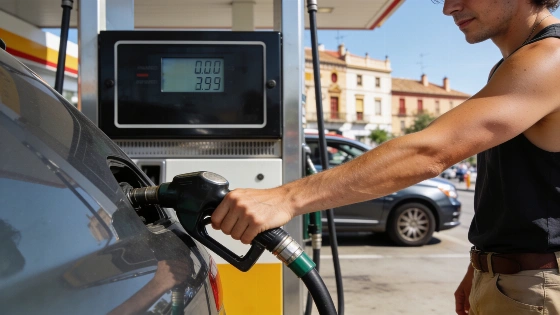
From August, filling up in Spain will cost significantly more. Tax discounts on fuel are reduced, while VAT remains at 21%. Drivers now face the highest prices of the year as summer travel peaks.
Spanish drivers will see a sharp increase in fuel costs starting this Saturday, as new tax rules come into effect. The government has reduced the discount on the Impuesto de Hidrocarburos from 15 to 10 cents per litre, while keeping VAT at 21%. This change means the average price to fill a 50-litre diesel tank will now exceed €91, and for petrol, the cost will surpass €86. The adjustment arrives at the height of the summer holiday season, directly impacting millions of motorists preparing for the August getaway.
The price jump is immediate: from August 1, both diesel and petrol will rise by six cents per litre. This follows a month in which fuel prices have already surged, with diesel climbing 18% and petrol 16% in July alone. The cost of diesel now stands at around €1.83 per litre, while petrol is at €1.73. The increase is not only due to the reduced tax discount but also the return of the standard VAT rate, which had been temporarily lowered to 10% until July.
These tax changes are part of the government’s latest anti-crisis decree, approved in June and ratified by Congress this week. The plan phases out the previous tax relief: 15 cents per litre in July, 10 cents in August, 5 cents in September, and no discount from October onwards. The Confederación Española de Empresarios de Estaciones de Servicio (CEEES) has criticised the timing, calling it an unnecessary blow during the busiest travel period. The organisation had urged the government to maintain the reduced VAT and fuel tax relief through the end of summer, arguing it was essential to protect both consumers’ purchasing power and the tourism sector.
The new tax regime coincides with a broader trend of rising energy costs in Spain. Alongside fuel, electricity prices have also increased compared to last summer. The combined effect has pushed inflation to 3.5%—the highest level seen in 2026—breaking a period of relative stability and moving further away from the European Central Bank’s 2% target. The government’s approach to managing energy taxes has drawn scrutiny, especially as the conflict between the United States and Iran has contributed to global fuel price volatility.
For context, Spain’s handling of energy-related funds and policies has faced challenges before. For example, recent analysis highlighted difficulties in executing EU wildfire prevention funds, with much of the allocated aid remaining unused. This pattern of complex policy shifts and incomplete implementation continues to shape the landscape for Spanish consumers and businesses.
As the summer peak approaches, the practical impact of these tax changes is clear: higher costs at the pump for families, tourists, and transport companies. The government’s phased withdrawal of fuel tax relief, combined with persistent inflation and rising energy prices, is set to make August one of the most expensive months for motorists in recent years. The debate over how best to balance fiscal policy, consumer protection, and economic recovery remains unresolved as Spain heads deeper into the holiday season.