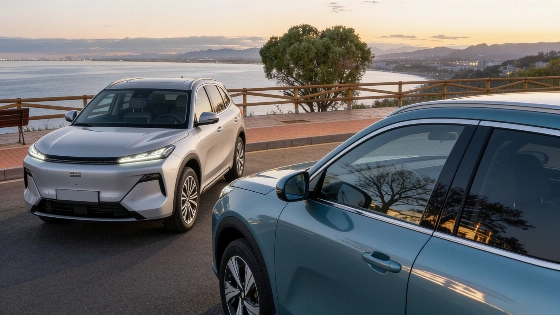
Geely has quietly sold over 2,000 cars in Spain this year while shaping the future of mobility across Europe. From satellites to London taxis, the company’s reach extends far beyond what most drivers realize.
Geely is no longer just a name on the horizon in Spain. The Chinese automaker has already registered 2,140 vehicles in the country this year, a sharp jump that signals more than just another brand entering the market. Until now, Geely had no recorded registrations in Spain during August in previous years, making this year’s surge in 2026 stand out even more.
Most car buyers still think of Geely as an Asian brand, but its influence runs through some of Europe’s most recognizable vehicles. The classic black taxis in London? Geely owns the London Electric Vehicle Company, which has turned these icons of British streets into modern electric cabs. The company didn’t just swap engines; it redesigned the air filtration system, showing how new ownership can change even the most familiar vehicles. Geely’s approach in Europe mixes launching its own brands with buying established ones.
In August 2026, Geely registered 757 cars in Spain in a single month, marking its strongest monthly performance to date in the country.
Geely’s ambitions go well beyond cars. In 2022, it launched nine GeeSAT-1 satellites through its subsidiary Geespace. These satellites aren’t for show—they provide high-precision positioning and communications for autonomous vehicles, drones, and logistics. The plan is to expand the network to 240 satellites. Each one is built to self-destruct safely after five years, helping to avoid space debris. Industry analysts see this as Geely moving to connect space technology with the next wave of mobility.
The company’s interest in new forms of transport doesn’t stop there. In 2017, Geely bought Terrafugia, a US startup working on flying cars. The idea of commuters taking to the skies is still out of reach, but the move shows Geely’s willingness to back ideas that most automakers avoid.
The Spanish passenger car market as a whole is experiencing robust growth: in August 2026, registrations reached 68,544 units, up 11.8% year-on-year, making it the strongest August since 2019. Geely’s new E2 model officially launched in Spain on September 9, 2026, with a starting price of 13,990 euros for financed purchases and pre-launch reservations reported by local media.
For Spanish buyers, Geely is more than a curiosity. The company once ran a design center in Barcelona, part of a global network with studios in Shanghai, Gothenburg, Coventry, and California. The Barcelona office has since closed, but it showed Geely’s intent to be more than just a seller in Europe—it wanted to design and innovate here, too.
Geely’s portfolio is packed with well-known names. Besides Volvo and Polestar, it controls Lotus, the British sports car brand. Since Geely took over in 2017, Lotus has shifted from lightweight sports cars to electric SUVs like the Lotus Eletre, while keeping its core identity. Geely also bought a 49.9% stake in Proton, Lotus’s former Malaysian parent, giving it more control and resources to invest in the brand.
Geely’s financial strength has opened doors in Europe’s car industry. In 2018, it became one of Mercedes’s largest shareholders by buying a 9.69% stake in Daimler AG. This wasn’t just a financial move. The two companies set up a joint venture to reinvent the Smart brand, moving it from small city cars to larger electric vehicles built on Geely’s SEA platform. The result: models like the Smart #1 and #3, which are shaped by Chinese engineering and investment.
Geely’s story is one of transformation. Founded in 1986 by Li Shufu in Zhejiang province, the company started out making refrigerator parts, decorative materials, and motorcycles. It wasn’t until 1997 that Geely built its first car, becoming China’s first private automaker. The early years focused on affordable cars for everyday drivers, but the company soon shifted toward technology and quality, paving the way for its global reach.
Geely’s rise is part of a larger trend of Chinese brands making inroads in Spain, as reported earlier. While competitors like BYD and Ebro have made headlines with fast sales, Geely’s approach is quieter—building its presence inside established European brands and laying the groundwork for long-term influence.
What makes Geely stand out isn’t just its ability to buy into well-known brands, but its readiness to try things others won’t. From launching satellites to exploring flying cars, Geely is betting that the future of mobility belongs to those willing to look beyond the next model year. For Spain, Geely’s growing footprint is a sign that the country’s car market is now part of a much bigger game. The real story isn’t just about sales numbers, but about how Geely is changing the industry from within.